The biggest theme in global markets has an awkward gap for Indian investors: the marquee AI winner, Nvidia, is American, and India makes no such chip. So the real question is not which Indian company is the next Nvidia, but where in the AI chain Indian firms actually sit, and how each one benefits. AI is far more than chips, and India is strong in several of the layers that matter.
Think of AI as a stack, from the software at the top to the electricity at the bottom. India has real players at most levels, and mapping them shows where the money flows.
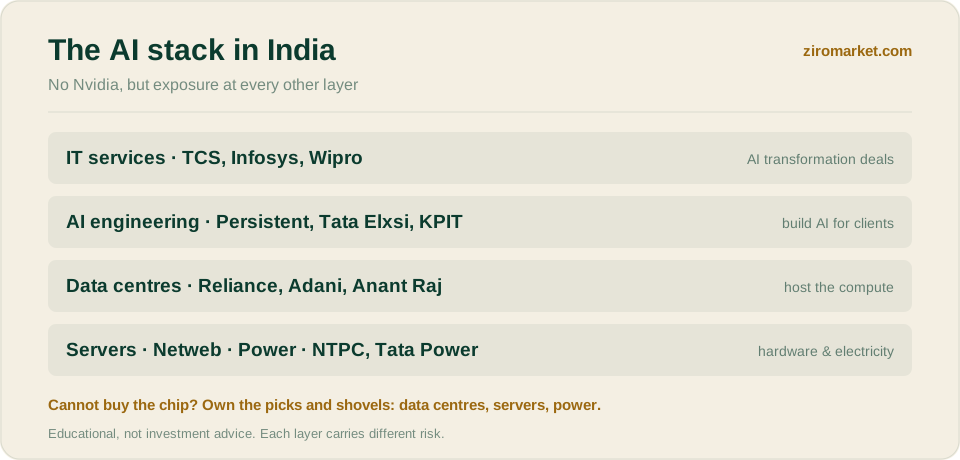
The AI Stack In India
Here is the chain, and who does what in India.
The lesson is that AI exposure in India is spread across software, real estate, hardware and energy, not concentrated in one chipmaker. That makes the theme broader, but it also means you have to know which layer you are betting on.
The Software Layers
IT services are the most direct AI play. Indian IT firms are winning large AI transformation deals from global clients, and the strong Q1 FY27 season, where Infosys raised its guidance, showed AI is starting to add work, as our IT Q1 FY27 scorecard detailed. TCS has also struck AI partnerships, covered in our TCS Mistral AI piece.
There is a catch, though. AI can also automate some of the coding and support work that IT services have historically sold, so the same sector is both an opportunity and a disruption story. The firms that turn AI into new revenue faster than it erodes old revenue are the ones that win.
Beyond the giants sit the specialists. Engineering and product firms like Persistent, Tata Elxsi and KPIT build AI systems, embedded software and automotive AI, giving more focused exposure to the build-out than the broad services majors.
The Physical Layers
AI needs somewhere to run, and that is a real-estate and energy story. AI models consume enormous computing power housed in data centres, which drives demand for the companies that build and operate them, such as Reliance, Adani and Anant Raj, whose data-centre push we covered in our Anant Raj data centre and AI data-centre capex and power pieces.
Hardware is the rarest India angle. Netweb Technologies is one of the few listed Indian makers of high-performance servers and AI systems, giving unusual domestic exposure to the hardware layer that is otherwise dominated by global names.
Why This Matters for Investors
AI is reshaping how markets are valued globally, and India is not a bystander. Even without a chipmaker, India offers exposure across the AI stack, from the IT services applying it to the data centres and power that run it, which is why the theme has become one of the market's strongest narratives, echoing the AI-driven records on Wall Street covered in our S&P 500 AI earnings piece.
The key is to be clear about which layer and which risk you are taking. Software exposure carries disruption risk; data-centre and power exposure is a longer-duration infrastructure bet; hardware is niche and volatile. Understanding the difference is what separates a thoughtful AI theme view from simply chasing a buzzword.
Risks to Monitor
The clearest risk is hype outrunning earnings. AI-themed stocks can run far ahead of the actual revenue AI generates, leaving them exposed to a correction.
A second risk is disruption within IT services, where AI could shrink parts of the traditional business even as it opens new work.
The third is execution and cost in data centres and power, which are capital-heavy and depend on land, electricity and demand materialising as planned. None of this is a recommendation to buy or sell any stock; it is a map of the theme. This is general information, not investment advice.
India may not have the chip at the centre of the AI boom, but it has real, listed exposure to almost everything around it: the software that applies AI, the data centres that run it, the servers inside them, and the power that keeps them on. For an Indian investor, playing the AI boom is less about finding the next Nvidia and more about deciding which layer of the stack you believe in.