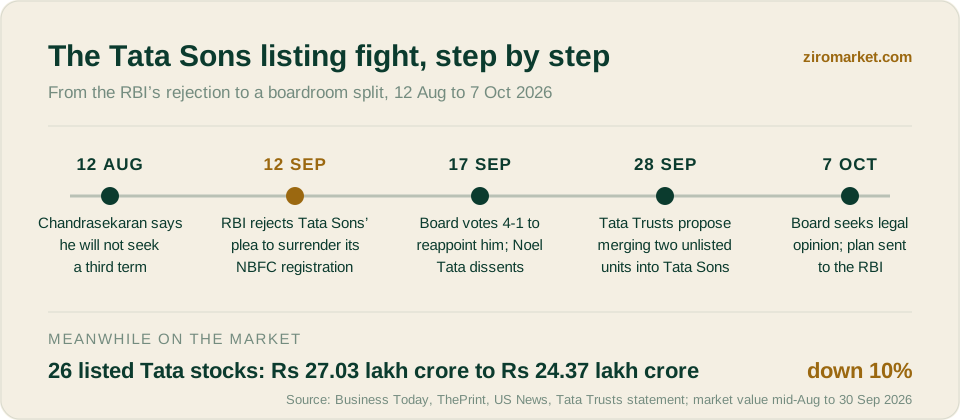
The Reserve Bank of India (RBI) has refused to let Tata Sons, the holding company behind TCS, Tata Steel and Titan, stay out of the stock market, and the fight over what happens next has coincided with a 10% fall in 26 listed Tata stocks. Between mid-August and 30 September 2026 those shares lost Rs 2,65,748 crore of combined market value, falling from Rs 27.03 lakh crore to Rs 24.37 lakh crore.
The row is about more than a share sale. It pits N Chandrasekaran, the Tata Sons chairman whose board has begun listing preparations, against Tata Trusts, led by Noel Tata, which owns about 66% of Tata Sons and has opposed a listing. On 7 October, Tata Sons' board sought legal advice on a Trusts plan designed to keep the holding company private.
Why is the RBI pushing Tata Sons to list?
The RBI classified Tata Sons as an upper-layer non-banking finance company (NBFC) in September 2022, and firms in that tier are required to list on a stock exchange, originally by 30 September 2025. An NBFC is a lender or investor that is not a bank, and Tata Sons counts because its main business is holding shares in group companies.
Tata Sons tried to opt out. In March 2024 it applied to surrender its registration as a core investment company after repaying more than Rs 21,000 crore of debt, and the RBI rejected that request in a letter that reached Tata Sons on 12 September 2026. Revised June 2026 rules put any NBFC with assets of Rs 1 lakh crore or more in the upper layer, and Tata Sons reported about Rs 2.01 lakh crore at 31 March 2026.

Who wants what in the Tata Sons fight?
Chandrasekaran told directors on 12 August he would not seek a third term, then the board voted 4 to 1 on 17 September to give him five more years from February 2027, with Noel Tata the lone dissent. Tata Trusts called the reappointment illegal, and it still needs shareholder approval at the next annual general meeting.
Which Tata stocks fell, and did any rise?
Twelve of the 26 listed Tata stocks fell by 10% or more between mid-August and 30 September 2026, and 23 of the 26 ended lower. TCS and Trent fell between 12% and 14%, and Titan, Tata Steel and Tata Power between 10% and 11%. The Nifty 50 itself fell about 8.7% over a similar stretch, from 24,570.65 on 7 August to 22,421.95 on 1 October, so much of the Tata decline matches a weak market, not just a governance discount.
The one pocket of gains came from companies that own Tata Sons shares directly. Tata Chemicals jumped 19.99%, from Rs 612.45 to Rs 734.90, after the RBI's rejection was reported, and TCS rose 5.23% to Rs 2,315.90, in a report dated 15 September. Seven listed Tata companies hold about 11.9% of Tata Sons between them.
What are Tata Trusts proposing instead?
Tata Trusts' 28 September proposal would merge two unlisted units, Tata Electronics Systems Solutions and Tata Consulting Engineers, into Tata Sons so its asset mix no longer looks like an NBFC's. The combined entity had operating revenue of Rs 1.05 lakh crore and financial assets of 64.3% of the total at 31 March 2026. The Trusts argue that would take Tata Sons outside the core investment company definition, though it needs RBI approval.
On 7 October the Tata Sons board sought a legal opinion on whether the plan is even valid, according to Business Today. The two main trusts, which together hold 51.54%, did not present it as a signed resolution, and the proposal has gone to the RBI. The board is unlikely to meet on it until its legal status is clear.
What would a Tata Sons listing be worth?
There is no official valuation or issue size, and press estimates from analysts range from Rs 9 lakh crore to Rs 12.5 lakh crore, against an underlying portfolio value of Rs 15 to 16 lakh crore. Those are back-calculations that apply a holding company discount, not figures from Tata Sons or the RBI.
What should Tata shareholders watch next?
TCS, the group's largest listed company, reports its September quarter results on 8 October 2026, the first of the group's big September-quarter results. HCLTech follows on 12 October and Infosys on 23 October for comparison across the IT sector.
The RBI's response to the merger plan is the decision that matters most, because it determines whether Tata Sons lists or finds a route to stay private. The shareholder vote on Chandrasekaran's reappointment is the second flashpoint, since Tata Trusts have called it illegal.
What are the risks?
A prolonged standoff between the board and the Trusts is itself the main risk, because it leaves 26 listed companies trading on governance headlines instead of earnings. A legal finding that the merger plan is invalid, or an RBI refusal, would push Tata Sons back toward listing. A deal that keeps it private would disappoint Shapoorji Pallonji, which wants a listing to realise the value of its stake. This is general information, not investment advice.
For 26 listed companies, the question is no longer only what Tata Sons is worth. It is who gets to decide.