Finance Minister Nirmala Sitharaman stepped up to present India's Union Budget for the ninth consecutive year on February 1, 2026, matching a record held by no other Finance Minister in India's post-independence history. The Budget 2026-27 was anchored on three big bets: a record Rs 12.2 lakh crore in public capital expenditure, a Rs 40,000 crore semiconductor manufacturing programme, and a cloud infrastructure tax holiday designed to make India a global data centre hub. The headline fiscal deficit target of 4.3% of GDP signals the government is continuing a gradual consolidation path while maintaining the growth push.
The overarching theme, Viksit Bharat or Developed India, is the same framework that has organised Indian budget-making for several years. The 2026 edition spent heavily on the infrastructure and manufacturing pillars of that vision.
What Happened
On February 1, 2026, FM Sitharaman delivered the budget speech. The Economic Survey 2026, released a day earlier, had projected GDP growth of 7.4% in FY26 and 6.8 to 7.2% in FY27. Against that growth backdrop, the budget's choices reflected a government confident enough in the growth momentum to sustain a large capex programme while still narrowing the fiscal deficit.
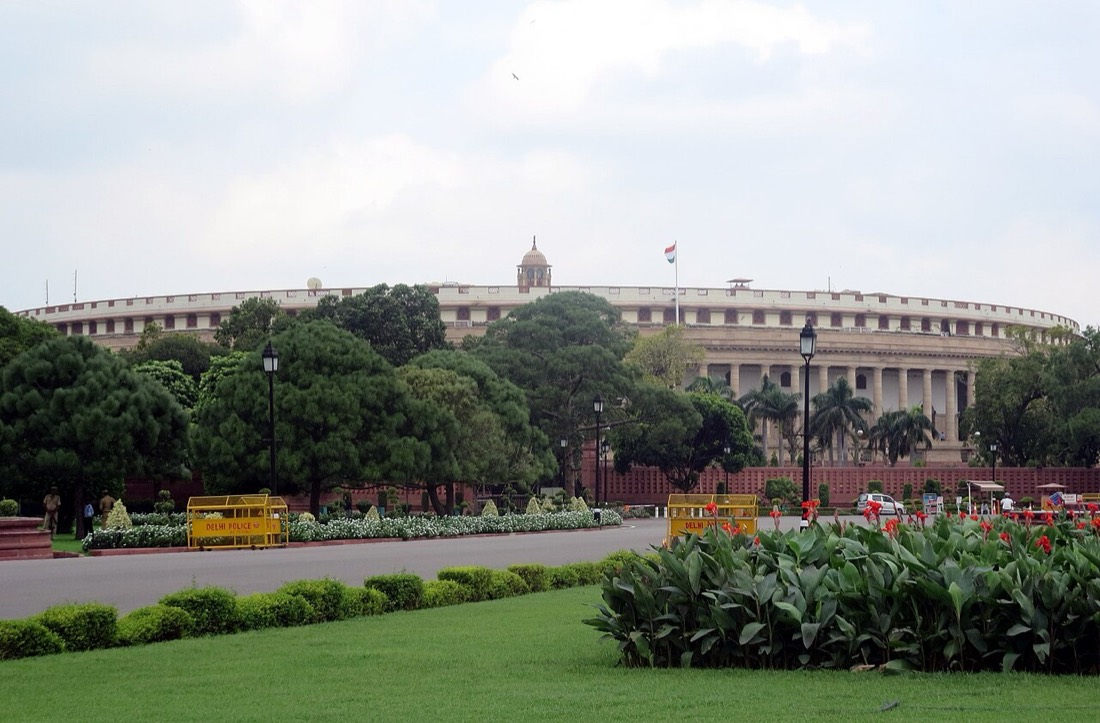
The single largest announcement by rupee value was the capital expenditure allocation of Rs 12.2 lakh crore. This is a record for any Indian budget and continues the multi-year pattern of the government crowding-in private investment by building transport, power, and logistics infrastructure first. The money flows into roads through the National Highways Authority, into railways, ports, urban metro projects, and water infrastructure.
Semiconductor Mission 2.0 was the other major strategic announcement. Rs 40,000 crore was allocated to the Electronics Components Manufacturing Scheme, building on the first phase of the semiconductor mission that had attracted Micron, Tata Electronics, and others to set up chip manufacturing and assembly in India. Mission 2.0 targets both component manufacturing and design ecosystem development.
The cloud tax holiday, granting relief to foreign companies providing global cloud services using Indian data centres until 2047, is a multi-decade incentive designed to make India a data sovereignty and cloud services hub. Global cloud providers operating through India-based infrastructure benefit from this relief, as do Indian data centre companies whose revenue depends on hyperscaler demand.
Income taxes stayed unchanged. Under the new regime, Rs 12 lakh of annual income remains tax-free, and Rs 12.75 lakh for salaried individuals after the standard deduction. The government chose not to expand the direct tax relief it gave in Budget 2025, which had been a significant middle-class stimulus that boosted consumption in FY26.
The single largest announcement by rupee value was the capital expenditure allocation of Rs 12.2 lakh crore.
Why This Matters for Investors
The capex push of Rs 12.2 lakh crore is the budget's most direct market signal. Government capital expenditure flows directly into infrastructure companies: construction firms, cement manufacturers, steel producers, engineering companies, and logistics providers. Every rupee of highway spending buys cement, steel, and labour. Every metro project creates demand for rail equipment and civil engineering services.
For equity investors, the capex budget is a demand visibility statement for a set of industries. Companies like L&T, Siemens India, ABB India, UltraTech Cement, and Bharti Hexacom read the annual capex budget as a forward order book signal. A Rs 12.2 lakh crore allocation, if executed on the historical execution rate of 75 to 80%, implies Rs 9 to 10 lakh crore of actual spending in the year.
Semiconductor Mission 2.0 is a long-cycle investment in India's electronics manufacturing capability. The immediate beneficiaries are the Tata-Sony joint venture and Micron's Gujarat packaging facility. The broader ecosystem effect will be visible over 5 to 10 years as design companies, equipment suppliers, and testing facilities grow around anchor semiconductor plants.
The cloud tax holiday reinforces the data centre investment thesis already visible in Anant Raj's Rs 25,000 crore Haryana MoU and multiple other large announcements. With tax incentives aligned to attract hyperscaler investment through 2047, the data centre buildout in India has multi-decade policy support behind it.
Market Reaction
Indian equity markets reacted positively to the Budget on February 1, 2026. The Nifty 50 and Sensex traded higher through the budget speech, with infrastructure, capital goods, and defence sectors seeing the strongest moves. Capex-heavy announcements typically rally industrials and construction stocks.
The absence of new taxes on long-term capital gains or securities transaction tax changes was broadly welcomed by market participants. Budget day anxiety around potential tax changes was resolved without negative surprises.
The fiscal consolidation path of 4.3% deficit targeting, marginally below 4.4% revised estimate, was seen as credible given the government's track record of meeting or beating its fiscal deficit targets in recent years. Bond markets reacted with modest yield compression, as a disciplined fiscal stance reduces government borrowing requirements.
What Investors Should Watch
Capital expenditure execution is the performance metric for the budget's biggest promise. In recent years, the central government has executed 85 to 90% of the budgeted capex, a significant improvement from the 65 to 70% historical average. If execution continues at that rate, the Rs 12.2 lakh crore allocation translates into Rs 10 to 11 lakh crore of real spending. Track monthly infrastructure ministry spending data through the year as a leading indicator.
Semiconductor Mission 2.0 milestones to watch include SEBI filings or government announcements on approved investment projects, land allocation for new fabrication facilities, and updates from Tata Electronics and new entrants on construction timelines.
Watch state government capex as well. The Union Budget's capex is only part of the total public investment picture. States receive funds from the centre and run their own capital programmes. A state-level capex slowdown, which can happen when state fiscal positions are stressed, would partially offset the Union Budget push.
Risks to Monitor
Budget execution risk is real and historical. Infrastructure projects in India frequently face land acquisition delays, environmental clearances, and contractor capacity constraints. The Rs 12.2 lakh crore allocation is the announced intent; actual spending depends on implementation machinery across dozens of ministries and agencies.
The fiscal consolidation path depends on tax revenue performing. If India's GDP growth disappoints in FY27, tax revenues could come in below budget estimates, forcing the government to choose between cutting capex or widening the deficit. An FY27 GDP growth rate below 6.5% would create fiscal stress that the markets have not priced.
The semiconductor mission's long payback horizon means the Rs 40,000 crore outlay will not generate returns for years. In the interim, it represents fiscal expenditure without near-term economic feedback. Critics of the semiconductor push argue that India should be building on comparative advantages in software and design rather than competing with Taiwan and South Korea in chip manufacturing, where capex requirements are enormous and technology moats are deep.
Union Budget 2026 is a document of ambition on multiple fronts simultaneously: infrastructure, chips, data centres, healthcare, education, and rails. The risk in ambitious multi-front budgets is diffusion. Whether the priorities are funded deeply enough to achieve impact, or spread so widely that none achieve critical mass, will be answered by implementation over the next three years.