Every investor eventually meets the taxman, and the moment you sell at a profit, one question decides how much you keep: how long did you hold it? For tax year 2026-27, short-term gains on listed shares and equity funds are taxed at 20% and long-term gains at 12.5% on anything above a Rs 1.25 lakh annual exemption, while debt funds bought after March 2023 are taxed at your slab rate however long you hold them. Get the holding period right and the tax difference can be larger than a year's dividends.
The rates were reset in the July 2024 Budget and Budget 2026 left them alone. What did change in 2026 is the law they sit in and a few rules around them.
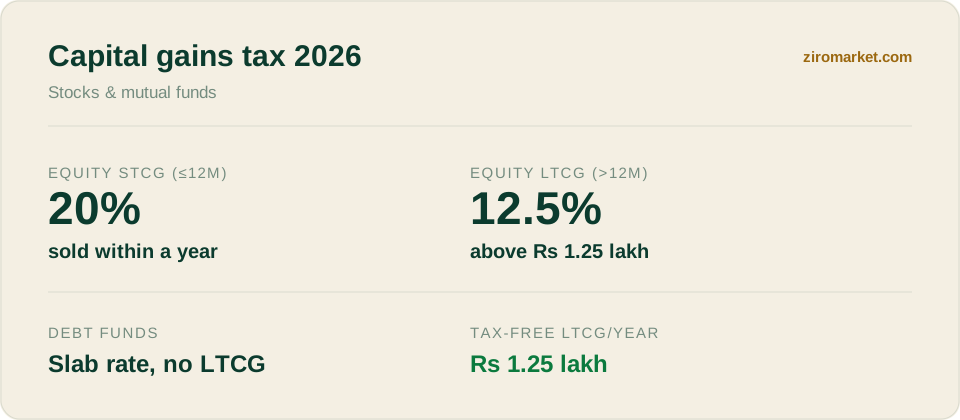
Which rates actually apply to you?
For most retail investors, three buckets cover almost everything: listed equity, equity mutual funds, and debt funds. The single biggest lever is the 12-month line for equity, because crossing it drops your rate from 20% to 12.5% and unlocks the annual exemption.
Surcharge and a 4% health-and-education cess sit on top of these rates. The Rs 1.25 lakh exemption resets every financial year and applies across all your eligible equity long-term gains combined, not per stock or per fund.
Why does the holding period matter so much?
Take a Rs 3 lakh profit on an equity fund. Sell inside 12 months and you pay 20% on the whole Rs 3 lakh, roughly Rs 60,000; hold past 12 months and only Rs 1.75 lakh is taxable at 12.5%, about Rs 21,875. Same profit, a third of the tax, purely because of the calendar.
SIP investors need one extra rule. Every SIP instalment has its own 12-month clock, and units are redeemed first-in, first-out, so if you have been investing Rs 10,000 a month for 18 months and redeem everything, the last six instalments are still short-term and taxed at 20%. Redeeming only the units older than a year keeps the whole gain long-term.
The debt side works differently. Since April 2023, debt funds lost their long-term advantage, so a debt fund held for five years is taxed exactly like one held for five months, at your slab rate. For someone in the 30% bracket, that makes a debt fund roughly as tax-efficient as a fixed deposit.

How do losses and the exemption save you money?
Losses are not wasted. A short-term capital loss can be set off against both short-term and long-term gains, but a long-term loss can only be set off against long-term gains, and anything unused carries forward for eight years, provided you file your return by the due date.
That last row drives a legal habit called gains harvesting. Selling equity holdings with up to Rs 1.25 lakh of long-term gain before 31 March and buying them back resets your cost price higher at zero tax, which shrinks the taxable gain when you finally sell years later. The mirror move, booking losses to offset gains, is called tax-loss harvesting.
Which details catch people out?
The low rates apply only where securities transaction tax is paid, which covers normal exchange trades but not unlisted shares. Unlisted and foreign shares get a 24-month long-term threshold and no Rs 1.25 lakh exemption, so they follow different arithmetic entirely. Shares bought before 1 February 2018 still get grandfathered, with the 31 January 2018 closing price used as cost if it was higher than what you paid.
The new-regime rebate is another trap. The rebate that makes income up to Rs 12 lakh tax-free does not cover equity gains taxed at the special 20% and 12.5% rates, so a salaried investor under that threshold can still owe capital gains tax. Our old vs new tax regime explainer works through where each one wins.
Gold and silver ETFs are not equity either. Their long-term gains are taxed at 12.5% after 12 months but without the Rs 1.25 lakh exemption, a point worth checking before you assume your gold fund gets the same break as your Nifty fund; our guide on how to invest in gold in India covers those vehicles.
Buybacks have come full circle. From 1 April 2026, what an ordinary shareholder receives in a buyback is taxed as a capital gain on the profit, not as dividend on the whole amount as it was from October 2024, which makes tendering shares into a buyback worth a second look again. Dividends, by contrast, are still taxed at your slab rate, as how dividends are taxed in India explains.