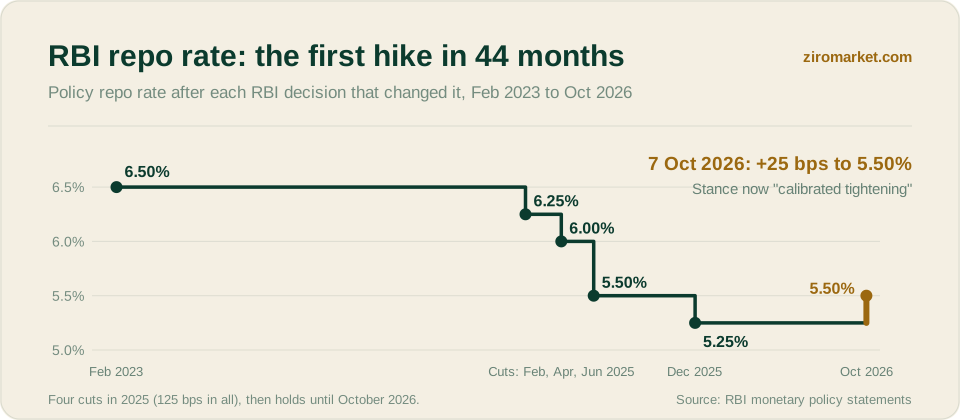
The Reserve Bank of India (RBI) has just done what it had not done in more than three and a half years. The RBI raised its repo rate by 25 basis points to 5.50% on 7 October 2026, its first hike since February 2023, and changed its policy stance from neutral to 'calibrated tightening'. All six members of the Monetary Policy Committee (MPC) voted for the increase, ending four straight meetings at 5.25%.
For borrowers the practical question is simple. Anyone with a floating-rate loan linked to the repo rate will see the extra 0.25 percentage points at the next reset date, either as a higher EMI or as a longer loan. Governor Sanjay Malhotra also went beyond the hike itself: he said rate cuts are off the table in the near term.
What exactly did the RBI decide on 7 October?
The MPC raised the repo rate to 5.50%, set the standing deposit facility rate at 5.25% and the marginal standing facility rate and bank rate at 5.75%, and projected 5.2% inflation and 7.1% growth for FY27. The repo rate is the rate at which the RBI lends short-term money to banks, and every floating-rate loan in the country is priced off it, directly or indirectly. In the table below, Q2 FY27 is July to September 2026 and Q4 FY27 is January to March 2027.
Why did the RBI hike now?
The RBI's own forecast shows inflation touching 6.0% in the October to December quarter, the ceiling of its 2% to 6% tolerance band around a 4% target. The latest actual reading was 4.82% for August, a seven-month high with food inflation at 5.95%, as our India CPI August 2026 analysis covers.
Outside forces did the rest. Brent crude traded around $100 a barrel on 1 October, the rupee has slid past 96 to the dollar, and the US 10-year Treasury yield has climbed to about 5.3%, its highest since 2002, according to market reports. Foreign investors sold about Rs 10,148 crore of Indian shares in a single session on 30 September, a pressure our Nifty losing streak piece tracks, and the US Federal Reserve raised its own rate in September, as our Fed dot plot explainer covers.
Rate cuts are off the table in the near term, and policy action ahead can only be a rate hike or a pause.
What happens to your home loan EMI?
A 25 basis point rise adds about Rs 794 a month to the EMI on a Rs 50 lakh, 20-year home loan. The table assumes the lender passes on the full hike, taking the rate from 8.50% to 8.75%. It is an illustration, since your actual rate depends on your bank's spread.
If a bank keeps your EMI unchanged and extends the loan instead, a 25 basis point rise adds about 12 months to a 20-year loan, whatever its size. RBI's 2023 framework for floating-rate loans says lenders must offer you the choice of a higher EMI, a longer tenure or a mix, and a switch to a fixed rate at reset. SBI Managing Director Rana Ashutosh Kumar Singh said floating-rate EMIs could rise, but that the hike is unlikely to dent credit growth much. Our repo rate to EMI explainer shows how your reset date decides when the change lands.
What does it mean for fixed deposits?
Fixed deposit rates usually follow the repo rate with a lag, so any increase will arrive bank by bank over the coming weeks, not on announcement day. Deposit rates fell through 2025 as the RBI cut by a cumulative 125 basis points, so a hiking cycle eases some of that pressure on savers. How much each bank passes on will differ.
How did the market react?
The Sensex fell 429.11 points, or 0.59%, to 72,638.70, and the Nifty 50 lost 173.05 points, or 0.76%, to 22,603.05, a day after the Sensex had gained 685 points. The rupee was at 96.45 to the dollar before the announcement. The Nifty still closed above its 1 October level of 22,421.95, which keeps open the chance that its eight-week losing streak ends this week.
What should borrowers and markets watch next?
September CPI inflation, due around 12 October, is the first test of the RBI's 5.2% FY27 forecast. With July at 4.45% and August at 4.82%, the RBI's 4.9% projection for July to September implies a September reading above 5%, so a print below that would be a pleasant surprise.
The MPC meets next on 2 to 4 December 2026, and the Governor's wording leaves only two options on the table: another hike or a pause. The RBI said the length and size of the cycle depend on how broad price pressures become.
What are the risks to this outlook?
The RBI is tightening into slowing growth, with its own forecast sliding from 7.2% in the July to September quarter to 6.8% by January to March 2027. If oil stays near $100 and the rupee keeps weakening, the RBI faces a harder trade-off between inflation and growth than at any point in 2025.
The hike itself is small: Rs 794 a month on a Rs 50 lakh loan. The signal is bigger, because the person who sets the rate has now said the next move cannot be down. This is general information, not investment or borrowing advice.