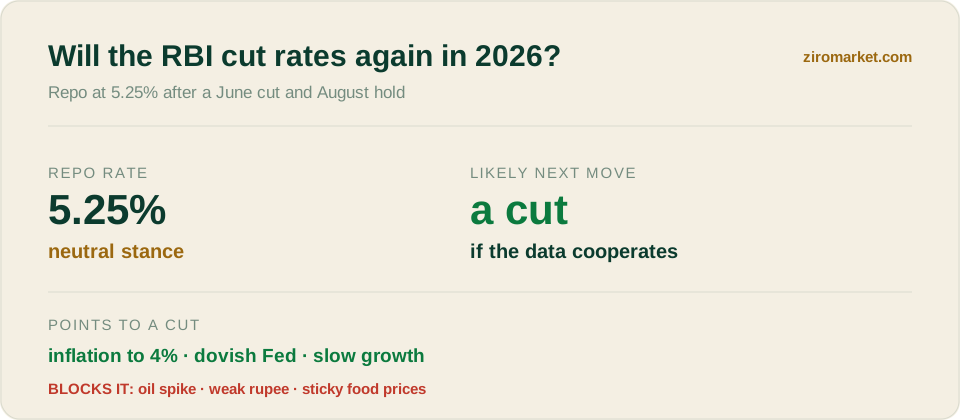
The RBI has done half a pivot, and the market wants to know if it will finish it. After cutting the repo rate to 5.25% in December 2025 and holding at every meeting of 2026, including a unanimous hold on 5 August, the RBI is on pause rather than on a path to cuts, and whether that cut lands in 2026 now depends on inflation, oil, the rupee and the US Fed. For anyone with a home loan or a stock portfolio, the answer matters.
This is a forward question, so it is about conditions, not a promise. Here is exactly what would tip the RBI one way or the other.
Where do rates stand now?

Whatever the committee decides, the effect on an individual loan depends on its benchmark and reset date, not on the announcement itself, explained in our repo rate and home loan EMI guide.
The easing cycle already happened. The repo rate is 5.25% as of September 2026, after 125 basis points of cuts through 2025 ending with a 25 basis-point cut on 5 December, with the standing deposit facility at 5.00% and the marginal standing facility at 5.50%. The neutral stance is the key tell: it keeps the door open to a cut without committing to one, as our RBI August 2026 decision coverage explains.
That backdrop has since turned hostile. The Federal Reserve delivered that hike on 16 September 2026, and the bond market pushed further: the US 10-year Treasury yield rose to 5.106% by 24 September, its highest since 2007, which removes the dovish-Fed condition the RBI needed, as our Fed dot plot explainer lays out.
What would make the RBI cut again?
Cooling inflation is the main trigger. August CPI was 4.82%, above the 4% target midpoint, so the RBI wants to see prices ease toward 4% before easing again, as our India June CPI coverage detailed. A run of softer inflation prints would clear the path.
Growth is the second lever. The RBI projected FY27 GDP growth at 6.7% in August, so if activity slows more than expected, the case for supporting growth with a cut strengthens. The third condition is the US Fed, and it is the one that has broken: the Fed has hiked and the 10-year yield keeps climbing, widening the rate differential, so an RBI cut into that gap would put the rupee under direct pressure.
What could stop a cut?
The blockers are all about imported and food inflation. Here is the tug-of-war.
The single biggest blocker is oil, because India imports most of its crude, so a jump raises inflation and pressures the rupee at once, undoing the very conditions a cut needs. A below-normal monsoon that keeps food prices firm, or a hawkish surprise from the Fed, would also push a cut further out.
What a cut would mean for you
For borrowers, a cut is slow relief. A lower repo rate feeds into floating-rate home, car and business loans over a few months, gradually reducing EMIs, though the pass-through is not instant. For savers, the flip side is lower deposit rates, which is why locking a longer fixed deposit before a cut can make sense.
For the market, rate cuts favour the rate-sensitive sectors. Banks, autos and real estate tend to rally on the prospect of cheaper money, which is part of why rate expectations move Indian sectors so sharply, as our Indian stock market today wrap describes.
The timing has a catch, though. Even when the RBI cuts, banks pass it on gradually, and only floating-rate loans linked to an external benchmark reprice quickly, so fixed-rate borrowers may see little immediate change. The bigger early effect is often on confidence: the signal that rates are heading down can lift consumer and business sentiment, and the market, well before the EMI relief actually shows up in your account.
For savers, the logic runs the other way. The window to lock in a high fixed-deposit rate narrows as a cut nears, which is why the weeks before an expected cut often see a rush into longer-tenure deposits. A rate cycle rewards borrowers and the market on the way down, and savers who acted before it turned.
What to watch
The first thing to watch is the monthly inflation print. A clear move toward 4% is the strongest green light for a cut.
The second is oil and the rupee, the pair most likely to force the RBI to wait.
The third is the US Fed's tone at its next meeting and the path of the 10-year yield. A Fed that turns dovish from here would widen the RBI's room to ease later; a yield that keeps climbing narrows it further.
Risks to monitor
The clearest risk is an oil shock that revives inflation and takes a cut off the table.
A second is a weak monsoon finish that keeps food inflation sticky, complicating the easing path.
The third is misreading the RBI: a "neutral" stance means data-dependent, so a single bad inflation or currency month can delay a cut that looked close. This is general information, not investment advice.
The external constraint has tightened since this was written. The Federal Reserve hiked on 16 September as expected, and the US 10-year yield has kept rising since, which argues for patience, and chair Kevin Warsh's first Jackson Hole speech on 28 August was the turning point that set this in motion.
The RBI has shown its hand: a year of pauses after 125 basis points of cuts, and a neutral stance that leans toward patience. Whether it cuts again in 2026 is now a question the data will answer month by month, on inflation, oil and the rupee. If those cooperate, cheaper EMIs and a friendlier market are the likely reward; if they do not, the RBI has already shown it is happy to wait.