The biggest buyers in the gold market are not traders or jewellers; they are governments. Central banks have been buying gold at the fastest pace in modern history, adding roughly 1,000 tonnes a year, led by China, Russia and India, as they swap dollars for bullion. It is one of the most important and least understood forces behind gold's climb to record highs, and it is rooted in geopolitics as much as economics.
This is not a short-term trade. It is a slow, deliberate shift in how the world's most powerful financial institutions store their wealth, and it says a lot about where the global economy is heading.
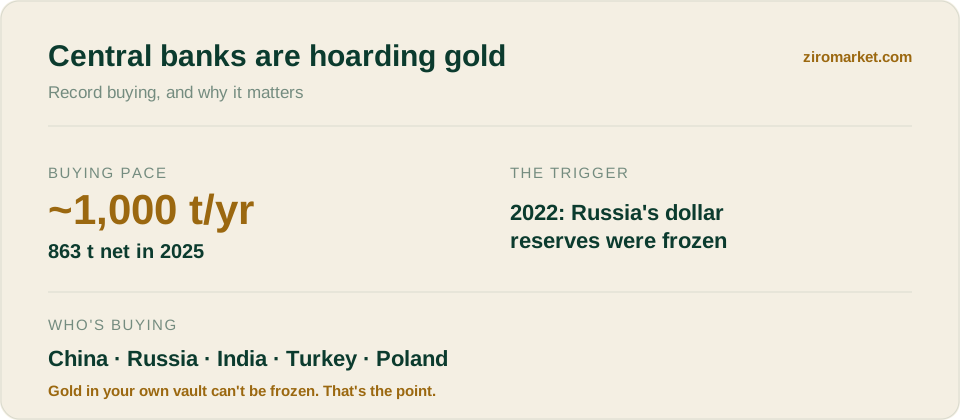
The Record Buying Spree
The numbers are historic. Central banks have added gold on the order of 1,000 tonnes a year in recent years, including about 863 tonnes net in 2025, extending well over a decade of continuous net buying. That is far above the long-term average, and it has turned central banks into one of the largest and steadiest sources of gold demand in the world.
The pace matters as much as the total. Unlike investors who trade in and out, central banks buy for strategic reasons and rarely sell, so their demand is durable and price-insensitive. That is exactly the kind of buying that puts a lasting floor under a market, which is why it has been so powerful for gold, as our gold at an all-time high coverage detailed.
Why They Are Doing It
The trigger was a wake-up call. When the US and its allies froze Russia's dollar reserves in 2022, it showed that dollars held abroad can be blocked in a conflict, while gold in your own vault cannot, a lesson that reshaped how many countries think about safety. Gold is nobody's liability, so it cannot be frozen, sanctioned or defaulted on.
Diversification is the second reason. Holding most reserves in one currency, the dollar, is a concentration risk, and gold offers an alternative that does not depend on any single government. This is the heart of the de-dollarization story, as our de-dollarization in 2026 piece explains, where the dollar still dominates but its grip is slowly loosening.
The third is a hedge against uncertainty. In a world of wars, sanctions, high debt and inflation, gold is a time-tested store of value, so central banks buy it as insurance against exactly the kind of turmoil that has defined recent years.
Who Is Buying
The buying is led by emerging economies.
The common thread is a desire for independence from the US dollar and the Western financial system. China and Russia lead the strategic push, while India, Turkey, Poland and others buy for a mix of safety, diversification and inflation protection.
What It Means For Gold
The impact on prices is structural, not temporary. Because central bank buying is large, steady and driven by strategy rather than profit, it provides a durable floor and an upward push that helped drive gold to a record near $5,602 an ounce in early 2026, as our gold price today page tracks. Even after pulling back, gold remains historically elevated, and this buying is a big reason why.
It also changes gold's role. Gold is being re-established as a core reserve asset for the first time in decades, which supports the long-term bull case that many banks still back. As long as central banks keep buying, one of gold's biggest demand pillars stays firmly in place.
For Indian Investors
The RBI is part of this story. The Reserve Bank of India has been steadily raising its gold reserves and bringing some gold held abroad back home, mirroring the global trend, and gold now forms a meaningful share of India's reserves. India is also the world's second-largest consumer of gold through households.
For Indian investors, the takeaway is context, not a trade signal. Central bank buying is a structural tailwind for gold, but it does not remove gold's short-term swings, which still respond to the dollar and interest rates. For the practical formats, see our how to invest in gold in India guide and the gold vs silver in 2026 comparison.
Risks to Monitor
The clearest risk is that the buying slows. If central banks reduce their purchases, one of gold's biggest demand pillars would weaken, removing some support from the price.
A second risk is the dollar and rates. A strong dollar and high interest rates can pull gold down in the short term even as central banks keep buying, since gold pays no yield.
The third is that de-dollarization stalls. The dollar still dominates global reserves, and any renewed confidence in it could slow the shift toward gold. This is general information, not investment advice.
Central banks buying gold like never before is a quiet vote of no confidence in a dollar-centric world, cast one tonne at a time. It will not end the dollar's dominance soon, but it has already reshaped the gold market, turning the world's most cautious institutions into its most committed buyers. As long as that continues, gold has a buyer that never really leaves.