The AI boom needs somewhere to live, and increasingly that somewhere is India. Global cloud giants and Indian conglomerates are pouring billions into data centers across India in 2026, driven by AI demand and data-localization rules, in a building spree that has become one of the clearest ways to play the AI theme with Indian stocks. The catch, as everywhere, is power.
This is the Indian chapter of a global story. Worldwide, hyperscalers are spending around $690 billion on AI infrastructure this year, and India is grabbing a growing slice of it.
Why India, Why Now
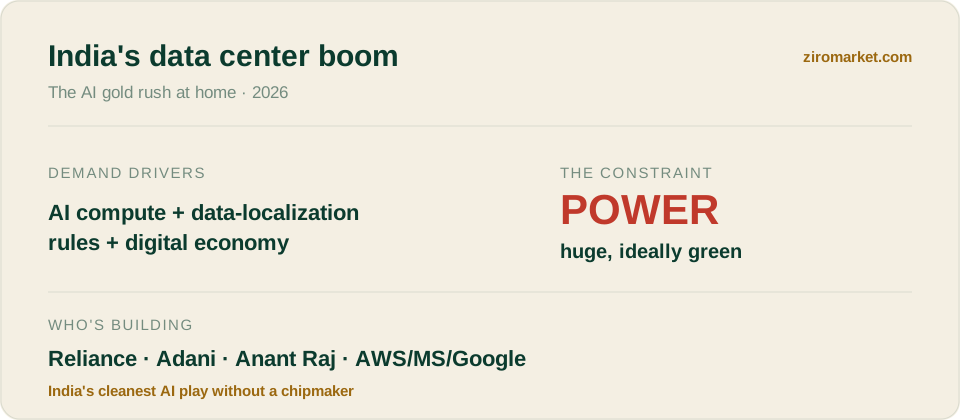
Three forces are converging. AI needs vast computing power, data-localization rules increasingly require Indian data to be stored within the country, and India's digital economy keeps growing, all of which drive demand for data centers. Together they have turned India into one of the world's most attractive data center markets.
Cost and talent help too. India offers cheaper land and labour than developed markets and a deep pool of engineers, which makes it appealing for global cloud giants expanding capacity. Hubs are forming around Mumbai, Chennai, Hyderabad and Noida, each competing to attract the next wave of investment.
The scale of demand is what makes it a boom. As AI moves from experiment to everyday use across Indian business and government, the computing it requires multiplies, and that computing has to run somewhere physical, which is exactly what a data center provides.
Who Is Building
The field spans global giants and Indian conglomerates.
Reliance and Adani are the most aggressive because they can combine the three things a data center needs: land, power and capital. Their energy businesses give them a decisive edge in securing the electricity these facilities demand, as our Reliance Q1 FY27 and Adani record capex coverage shows, while smaller names like Anant Raj have re-rated on the theme.
The Power Problem
Electricity is the real bottleneck. Data centers, and AI ones especially, consume enormous amounts of power and need a reliable, ideally green, supply, so securing enough affordable, dependable electricity is the main constraint on how fast India can build. It is the same wall the global build-out has hit, as our AI data center power crunch piece explained.
That constraint is also an opportunity. The power demand from data centers is a tailwind for electricity generators, renewable-energy developers and grid companies, since every new facility needs a long-term, high-volume power supply. Cooling and water management are the next challenges, adding more suppliers to the ecosystem.
Why This Matters for Investors
The data center boom is one of the cleanest Indian AI plays. Because India has no chipmaker like Nvidia, the physical infrastructure layer, data centers and the power that runs them, is one of the most direct ways to get exposure to the AI build-out through Indian stocks, as our AI stocks in India guide maps out. It turns a global technology theme into a domestic real-estate-and-energy story.
The exposure spans several layers. There are the conglomerates building at scale, the smaller listed developers, the power and renewable companies that supply them, and the cooling, equipment and construction firms that serve them. Each is a different way to bet on the same trend, with different risk and growth profiles.
For investors, the appeal is that this is infrastructure with visible, long-term demand. Unlike a speculative tech bet, a data center leased to a cloud giant produces steady income for years, which is why patient capital, from conglomerates to global funds, is piling in.
There is a strategic dimension too. Data has become a national asset, and hosting it inside India, under Indian rules, is increasingly a matter of policy as much as economics. That gives the domestic build-out a tailwind that does not depend on the AI cycle alone: even without the AI frenzy, the shift to storing Indian data in India would keep demand growing. For long-term investors, that mix of a structural digital-economy trend and a cyclical AI boom is what makes the theme unusually durable, provided the power to run it can be found.
Risks to Monitor
The clearest risk is power. If reliable, affordable electricity, especially green power, cannot keep pace, it would cap how fast capacity grows and squeeze the economics.
A second risk is overbuilding. If too much capacity arrives at once, or AI demand disappoints, returns on these capital-heavy projects could fall short.
The third is hype. Data center and AI-linked stocks can run far ahead of actual earnings, leaving them exposed to a correction if the build-out slows. This is general information, not investment advice.
India's data center boom is where the global AI story meets Indian ground, land, power and concrete. It is one of the most tangible ways to invest in AI using Indian companies, and one of the most demanding, because it runs headlong into the country's power constraints. Whoever solves the electricity problem fastest, the conglomerates with their own energy or the developers who secure green supply, will build the most, and capture the most of the gold rush.