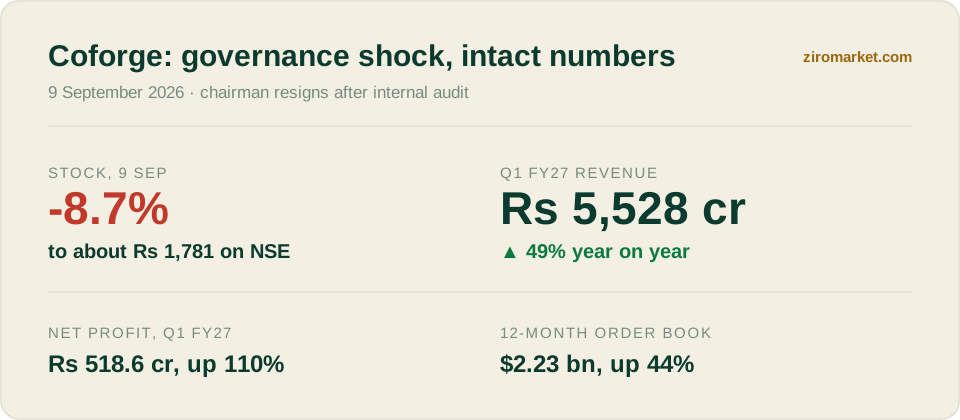
A company can report its best quarter in years and still lose 9% of its value in a day over a document nobody outside the boardroom has read. Coforge shares fell about 8.7% to roughly Rs 1,781 on the NSE on 9 September 2026 after chairman Om Prakash Bhatt resigned with immediate effect, following an internal audit that found material information about his own performance was not fully disclosed to the board.
Bhatt, the former State Bank of India chairman, said he had acted in good faith. He resigned while the board was still evaluating his response, writing that staying on amid a disagreement over his conduct in the evaluation process would not help the board function.
Coforge was quick to draw a boundary around the issue. The company said the matter concerns the board evaluation exercise of March and April 2026 and has nothing to do with its financial statements, its financial reporting, or any financial matter.
What happened
The trigger was routine on paper. Auditors, working through the company's internal audit plan, examined how the March and April 2026 board evaluation was conducted and how the resulting Board Evaluation Report reached the board.
The review found concerns in the way the Board Evaluation Report had been dealt with and presented, specifically that certain material information contained in it, including information relating to the chairman's own performance, had not been fully disclosed to the board. Bhatt was the person under whose guidance that report reached the board, which is what makes the finding awkward rather than procedural.
He did not wait for the board to conclude. The resignation was tendered while directors were still considering his response, and the board accepted it with immediate effect, then designated non-executive independent director Vivek Sharma as interim chairperson until 31 January 2027.

What is a board evaluation, and why does it matter
A board evaluation is the annual exercise in which a listed company's board assesses its own performance, that of its committees, and of individual directors including the chairperson. Indian listed companies are required to carry out this evaluation under the Companies Act 2013 and SEBI's listing regulations, which is what turns an internal disagreement into a disclosure event.
The reason a market reacts to it is narrow and specific. An independent chairperson exists to be the check on management. When the check itself is the subject of an audit finding about incomplete disclosure to the board, investors are not repricing the earnings, they are repricing the reliability of everything the board signs off on.
The numbers were never in question. The person meant to vouch for them was.
Why this matters for investors
Coforge is not a company with a growth problem. For the June 2026 quarter it reported revenue of Rs 5,527.7 crore, up 49% year on year, with net profit up 110% to Rs 518.6 crore and a twelve-month executable order book of USD 2.23 billion, up 44%. EBITDA rose 74% to Rs 1,123.3 crore at a 20.3% margin, and fresh order wins in the quarter totalled USD 691 million.
The caveat inside those numbers predates this week. Much of that 49% revenue jump came from the Encora acquisition rather than organic growth, which means the underlying growth rate and the reported one are different animals, and integration quality is a board-level responsibility.
That is the link between the governance story and the business story. An acquisition-heavy growth strategy asks shareholders to trust board oversight more than an organic one does, because the value depends on integration decisions that do not show up in a quarterly print for years.
Market reaction
The selling was immediate and, by the standards of governance news, contained. Coforge fell as much as 9% intraday on 9 September 2026 and traded around Rs 1,781, a single-session move that wiped out more value than most earnings misses do, in a session where information technology stocks were already among the market's weakest with the Nifty 50 near 23,200 (as of 17 September 2026).
The sector backdrop did not help. Indian information technology stocks have been among the weaker performers through this earnings cycle, as our IT Q1 FY27 scorecard sets out, and foreign investors turned net sellers again in the first week of September.
At least one brokerage flagged limited operational impact, the standard institutional read when a governance event does not touch reported financials. That view rests entirely on the company's own assurance that the audit finding is contained to the evaluation process.
What investors should watch
The first thing is whether the interim arrangement becomes permanent quickly. A chairperson designated until 31 January 2027 is a placeholder, and how fast a full-time appointment arrives, and whether the appointee is genuinely independent of management, tells you how seriously the board is treating this.
The second is whether any regulatory correspondence follows. Disclosure obligations around board evaluations sit with SEBI, and the absence of further filings over the coming weeks would be the strongest signal that the matter really is closed.
The third is the next quarterly result, particularly organic growth stripped of the Encora contribution. Governance events fade from price charts when operating numbers keep landing, and they compound when they do not.
The fourth is whether other independent directors stay. A single resignation is an incident. A second one, for related reasons, changes the story from a disagreement to a pattern, and that is when institutional holders start reducing rather than holding.
Risks to monitor
The second risk is that acquisitions and governance interact badly. A company growing through deals needs an unusually credible board, and a chairperson exit over disclosure quality raises the bar for how the next transaction gets explained.
The third is simple sentiment mechanics. A stock-specific governance shock lands harder on a sector already under pressure from weak global technology spending and renewed foreign selling. This is general information, not investment advice.
What makes this one worth remembering is the ratio. A report about how a board rates itself, invisible to shareholders and unrelated to a single rupee of reported profit, moved roughly a tenth of a company's value in one session.