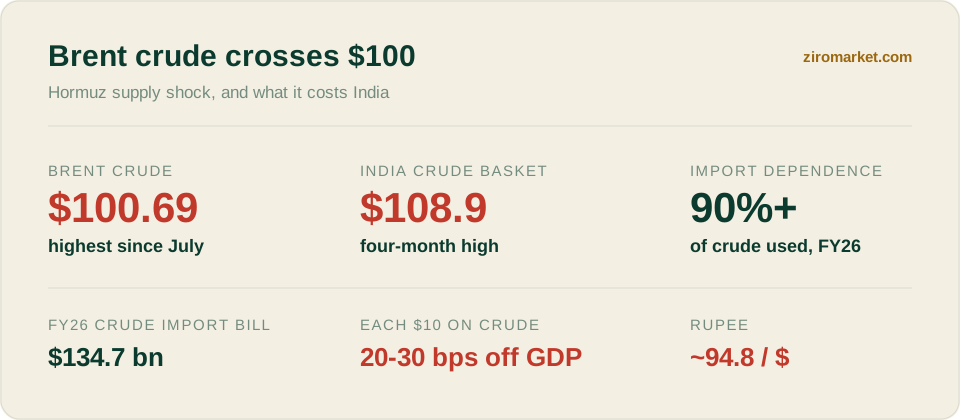
Oil has been the number every Indian macro forecast this year was quietly built around, and that number just broke. Brent crude futures moved above $100 a barrel on 9 September 2026, trading near $100.69, the first time since July, as United States and Iranian forces traded strikes around the Strait of Hormuz. India's own crude basket had already run ahead of Brent, hitting $108.9 a barrel, a four-month high.
The reason this matters more in Mumbai than in most capitals is arithmetic rather than sentiment. India's crude import dependence crossed 90% in FY26 according to EY, meaning more than nine of every ten barrels the country burns are bought in dollars from someone else. Domestic production has been sliding for over a decade while consumption climbs.
So a supply shock in the Gulf is not a foreign news story for India. It is an input cost, a currency event and a monetary policy constraint arriving at once.
What happened in the Gulf?
The conflict has moved from land to sea. The International Energy Agency has described the Hormuz disruption as the largest supply disruption in the history of the global oil market, with almost all traffic through the strait restricted. Roughly a fifth of the world's seaborne oil normally passes through that channel.
US forces struck Iranian oil tankers in early September after Iranian missiles were fired toward an American carrier group, and the US navy escorted 40 vessels carrying 18 million barrels through the strait in one wartime-high convoy. Iran has exported no oil since July under a US blockade, so a supplier is missing from the market at the same time the shipping route is being contested.
Why does $100 oil land harder on India?
Start with the bill. Crude alone cost India $134.7 billion in FY26, part of a $775 billion total import bill, and that was struck at an average price well below today's. The same volume at $100 costs materially more, and the extra is paid in dollars India has to buy.
The growth arithmetic is the part policymakers watch. Every $10 rise in crude is estimated to take 20 to 30 basis points off India's GDP growth, according to economist Sunil Sinha (September 2026). Brent has travelled from the mid-$80s in July to above $100 now, so a full quarter at these levels is worth roughly 30 to 45 basis points.
Then comes the currency. The rupee fell 0.35% to about 94.82 per dollar on 8 September 2026, its sharpest single-day drop since late July, with the Reserve Bank of India selling dollars to slow the move. India's foreign exchange reserves at a record $740.8 billion give the RBI unusual room to intervene, and it has reportedly sold at least $8 billion in a week, with some estimates closer to $15 billion. Reserves buy time. They do not change the import bill.
An oil shock reaches India as a bigger dollar bill, a weaker rupee, higher input costs and a central bank that cannot cut.
Market reaction
Indian equities have been selling off into the oil move. The Nifty 50 closed near 23,635 on 9 September 2026, down about 0.6%, and the Sensex fell about 0.7% to roughly 75,577, a second consecutive session of losses. Information technology led the decline, with Infosys, HCLTech and Tech Mahindra among the larger losers.
The sector split is the textbook one. Oil marketing companies BPCL, HPCL and Indian Oil fell as much as 3% earlier in the week on the crude surge, while aviation names IndiGo and SpiceJet slipped around 2%, though OMC stocks steadied on the day Brent actually printed $100. Upstream producers ONGC and Oil India sit on the other side, since higher crude lifts their realisations, while paint and tyre makers pay more for crude-derived inputs with a lag.
What investors should watch
The first is whether the price holds or spikes. A brief $100 print that fades leaves budget assumptions intact, while a full quarter above $100 changes the current account, the subsidy question and the inflation path. Our crude oil price today page tracks the level, and what happens if the Strait of Hormuz closes covers the full closure scenario.
The second is retail fuel pricing. Petrol and diesel rates have been held largely steady through 2026, which parks the cost on oil marketing company margins instead of consumer inflation. A sustained move above $100 forces a choice, and that choice decides whether the shock lands in the CPI print or in OMC earnings.
The third is the Federal Reserve on 16 September. Rate futures put the odds of a 25 basis point hike at roughly 63 to 65% after the 4 September 2026 jobs report, partly because energy costs are pushing inflation the wrong way. A hike strengthens the dollar and adds a second layer of pressure on the rupee, as our Fed rate hike September 2026 analysis explains. The US CPI release on 11 September lands first.
The fourth is that imported oil inflation takes RBI rate cuts off the table even if domestic growth softens, which is the uncomfortable combination for equity valuations, as how crude oil affects the Indian economy sets out.
Risks to monitor
The second risk runs the other way. A ceasefire or a negotiated de-escalation would unwind the war premium quickly, and oil at $100 built on geopolitics can fall as fast as it rose. Positioning built entirely on the shock persisting is a bet on the conflict, not on the economics.
The third is the sanctions overlay. India's Iranian oil window shut on 21 August 2026, removing a discounted source at the wrong moment, as our Iran sanctions piece covered. This is general information, not investment advice.
What makes this shock different from 2022 is the buffer. India met that one with a fatter discount on Russian crude and a smaller reserve stack. This one arrives with record reserves, a narrower discount and a shut Iranian window, which means the defence is stronger on the currency and weaker on the barrel.