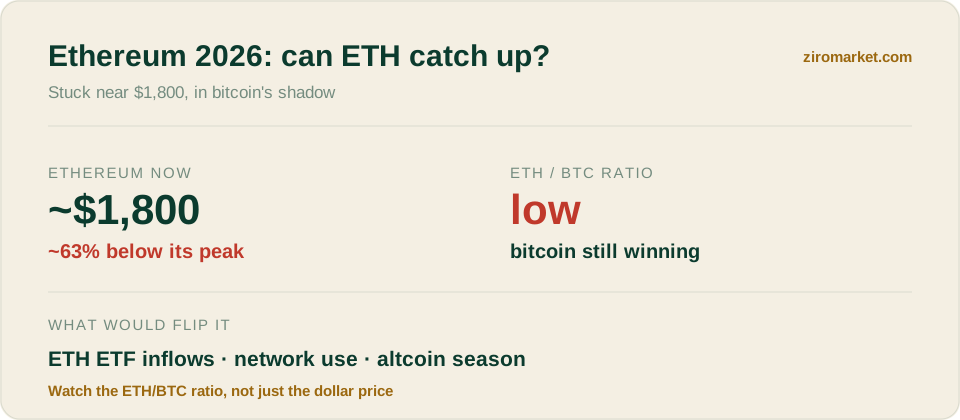
Ethereum has a bitcoin problem. The second-largest cryptocurrency trades near $1,800, far below its old highs, while bitcoin has raced ahead and now dominates the market, leaving ETH holders asking whether their coin can ever catch up. For years the two moved together; in 2026 they have decoupled, and not in Ethereum's favour.
The gap is not random. It comes down to where the money is going, and understanding that is the key to whether ETH closes it.
Why ETH Has Fallen Behind
Three forces have held Ethereum back. The biggest is that bitcoin's spot ETFs pulled huge institutional money specifically into bitcoin, lifting its dominance and leaving less flowing into ETH and other coins, a structural shift covered in our bitcoin dominance and altcoin season piece. When the big buyers want bitcoin, ETH struggles to keep pace.
The second is competition. Faster, cheaper blockchains, led by Solana, have taken some of the activity and attention that once flowed to Ethereum, as our Solana ecosystem coverage detailed. Ethereum is no longer the only serious smart-contract platform.
The third is its own uneven growth. Ethereum's usage and fees have not risen in a straight line, and while its layer-2 networks have made it cheaper to use, that has sometimes pulled activity and fees away from the main chain, complicating the value story, as our Ethereum price and staking ETF piece explained.
What Could Change It
The catalysts for a comeback are specific. The most powerful would be spot Ethereum ETFs attracting strong inflows, especially if they include staking, which would give institutions a yield and bring the kind of demand that lifted bitcoin. That single factor could reset the ETH story.
Network use is the second. If activity on Ethereum and its layer-2s grows, and more real-world assets and stablecoins settle on it, the demand for ETH as the network's fuel rises with it. Ethereum remains the largest home for stablecoins and tokenization, which is its strongest long-term card.
That long-term card is worth dwelling on. Ethereum is the settlement layer for most stablecoins and for the fast-growing business of tokenizing real-world assets like bonds, funds and treasury bills. If that shift of traditional finance onto blockchains accelerates, much of it is likely to run on Ethereum, which would give ETH a demand source with nothing to do with speculation. It is the slowest-moving catalyst, but potentially the most durable, because it would tie ETH's value to real financial plumbing rather than to the next rally. The risk is that rival chains or private networks capture that business instead, which is why the tokenization race matters so much to Ethereum's story.
The third is an altcoin season. Money tends to rotate from bitcoin into ETH and other coins only after bitcoin rallies and its dominance falls, so Ethereum's fate is tied to bitcoin's next big move, the range-break question we lay out in our bitcoin H2 2026 outlook. ETH usually leads when the rotation finally comes.
The Number To Watch
Forget the dollar price for a moment and watch the ratio. The ETH/BTC ratio, Ethereum's price measured in bitcoin, shows which coin is winning: when it rises, ETH is outperforming; when it falls, bitcoin dominates. In 2026 it has been low, which is the whole story in a single number.
For Indian Investors
The tax treatment is identical to bitcoin, and just as harsh. India taxes ETH gains at an effective 34%, with a 1% TDS and no loss offset, as our crypto tax India 2026 guide explains, which makes chasing a fast ETH bounce especially costly if the timing is wrong.
It also shapes behaviour. With a flat 30% tax and no set-off for losses, the heavy trading that some use to play ETH's volatility is punished, which is why many Indian holders take a longer view on whether the network, not the next swing, will pay off.
Risks to Monitor
The clearest risk is continued bitcoin dominance. If ETF money keeps concentrating in bitcoin, ETH could keep lagging no matter how good its technology is.
A second risk is competition. If Solana and other chains keep taking share, Ethereum's central role, and the demand for ETH, could erode further.
The third is a broad risk-off shock, where ETH, as a higher-risk asset than bitcoin, tends to fall harder and faster. This is general information, not investment advice.
Ethereum in 2026 is a story of a former co-leader trying to get off the bench. The technology case is intact, and the catalysts, ETF inflows, network growth and an altcoin season, are known. But until the ETH/BTC ratio turns, Ethereum remains in bitcoin's shadow, and catching up is a hope with a checklist rather than a trend you can yet see.