India has thousands of mutual funds, and the sheer number is what makes choosing one feel impossible. The good news is that a good choice comes down to five simple things: match the fund to your goal, keep costs low, favour index funds, judge on a long track record, and avoid chasing last year's winner. You do not need to be an expert; you need a checklist and the discipline to stick to it.
Here is that checklist, step by step, in plain language. It is educational, not investment advice.
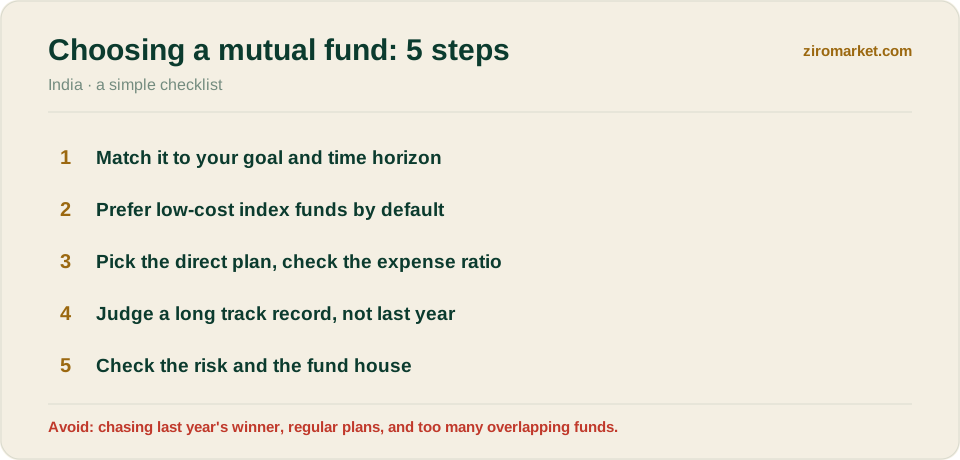
Step 1: Match the fund to your goal
Start with what the money is for, not with the fund. The type of fund should match your time horizon: equity funds for long-term goals five years away or more, debt funds for short-to-medium goals, and hybrid funds for a balanced middle. Buying an equity fund for money you need next year is the single most common structural mistake.
Here is the simple map.
Step 2: Prefer index funds unless you have a reason not to
An index fund simply copies an index like the Nifty 50, so it charges very little and needs no star manager. For most investors an index fund is the strongest default, because it costs less and most active funds fail to beat their benchmark consistently over the long run, especially in large caps. Active funds can earn their fees in less-efficient areas like mid and small caps, but that is the exception, not the rule, as our index funds vs active funds comparison shows in full.
The practical approach is an index fund as your core, and active funds only where you have a specific, considered reason to expect outperformance.
Step 3: Check the expense ratio and pick the direct plan
Cost is the one thing you fully control. The expense ratio is the annual fee a fund charges, and a direct plan, bought straight from the fund house with no distributor commission, always costs less than a regular plan for the exact same fund. Over 15 to 20 years, even a 1% yearly difference compounds into a large gap in your final corpus.
Illustrative arithmetic on assumed returns, not a forecast. Over 20 years, a one-percentage-point higher fee can cost more than half of everything you put in, which is the gap a regular plan's commission can open against the same fund's direct plan.
So two rules: favour lower expense ratios, and always choose the direct plan when you invest yourself, as our how to start investing in stocks in India guide explains alongside the basics.
Step 4: Judge the track record, not last year's return
Ignore the fund topping this year's charts. Look for a long, consistent track record across several market cycles rather than a single stellar year, because this year's best fund is often next year's laggard. Consistency, how a fund behaves in both good years and bad, tells you far more than a headline return.
Check how the fund did in falling markets too, not just rising ones. A fund that loses less in a downturn can beat a flashier one over a full cycle, which is what actually compounds your wealth.
Step 5: Check the risk and the fund house
Finally, match the risk to your stomach. A fund's volatility and how much it can fall matter as much as its returns, because the best fund is useless if you panic-sell it in a crash. Small-cap funds can double and halve; a large-cap or hybrid fund is steadier. Pick what you can actually hold through a bad year. Every scheme carries SEBI's six-level riskometer, from "Low" to "Very High", on its factsheet, and almost every equity fund sits at "Very High", which is the honest label for anything that can fall 15% in a quarter, as the Nifty did between January and April 2026.

The fund house matters too. A large, well-run asset manager with stable processes and a clear mandate, operating under SEBI's rules, is a safer home for your money than a fund built around one manager who might leave, as our SEBI mutual fund regulations coverage describes.
Common mistakes to avoid
Choosing a mutual fund is less about finding the perfect one and more about avoiding the obvious traps. Match it to your goal, keep it cheap, favour the index, judge it over years not months, and hold it through the rough patches. Do that, and the steady power of regular investing, through a SIP that keeps buying in every market, does most of the work for you over time.