It is the quiet debate that decides more of your long-term returns than any hot stock tip: should you buy a cheap fund that copies the market, or pay a manager to beat it? For most Indian investors the honest answer is that low-cost index funds win as a default, especially in large caps, because they cost far less and most active funds fail to beat their benchmark over the long run, while active funds still have a shot in smaller companies. It is less about which is "better" and more about where each one belongs.
Here is the trade-off in plain terms, without the ideology on either side. It is educational, not investment advice.
What is the difference?
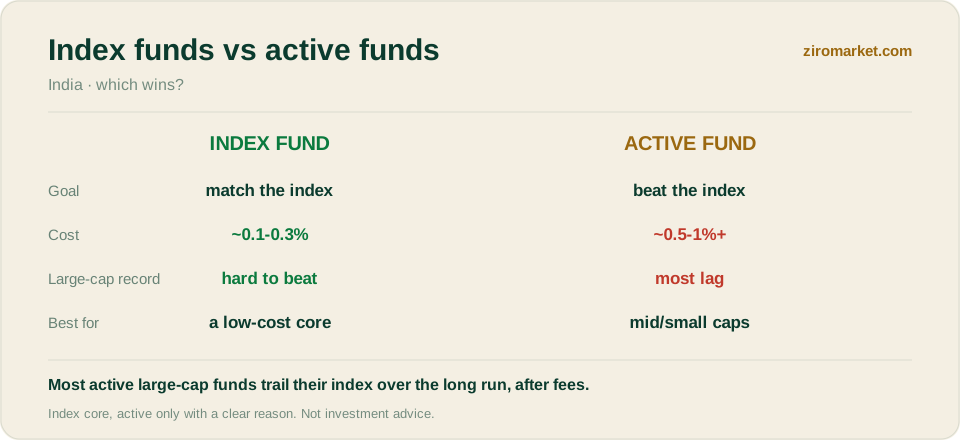
The two funds have opposite goals. An index fund passively copies an index like the Nifty 50 and charges a tiny fee, while an active fund pays a manager to pick stocks and try to beat that index for a higher fee. One aims to match the market; the other aims to beat it. That single difference drives everything else, including cost.
Here is the comparison at a glance.
Which performs better?
Over the long run, most active funds lose to their benchmark. The pattern in India, as around the world, is that a majority of active large-cap funds fail to beat their index over five and ten years once fees are counted, which is a hard fact for the pay-to-beat model. The index fund quietly captures the market return; most managers, after costs, capture less.
S&P Dow Jones Indices tracks this every six months in its SPIVA India scorecard, and the year-end 2025 edition is blunt.
Source: SPIVA India Year-End 2025 Scorecard. More than eight in ten active large-cap funds trailed their benchmark over the five years to December 2025, and in 2025 alone the S&P India LargeMidCap index rose 8.9% while the average large-cap fund, weighted equally, returned 7.3%.

The reason it holds up is arithmetic, not luck. If the market returns a certain amount, all investors together earn that minus their costs, so the higher an active fund's fee, the bigger the hurdle it must clear just to match a cheap index fund. Over decades, that fee gap compounds into a large difference.
Why active funds struggle
Two forces work against active managers. The first is cost: a higher expense ratio comes out of your returns every single year, so a manager has to beat the index by more than the fee just to break even. The second is efficiency, since in well-researched large caps, most information is already in prices, making consistent winners genuinely hard to find.
This is why the large-cap space is the hardest for active funds. So many analysts cover the biggest companies that an edge is rare, and the fee makes matching the index, let alone beating it, an uphill task year after year.
When active funds can win
Active is not pointless; it is just misapplied in large caps. Active funds have a better chance in less-efficient segments like mid-cap and small-cap stocks, where good research can still find companies the market has mispriced. They can also give exposure to specific themes or strategies an index does not offer.
The same SPIVA report shows why the smaller end is different: in 2025, a majority of active mid- and small-cap funds beat their benchmark, their best relative showing since 2014. Even there, though, the win is inconsistent year to year and the cost is real, so the case for active is strongest at the smaller, under-researched end of the market and weakest at the large-cap top. Picking a good active fund also means judging the manager, which our how to choose a mutual fund guide covers.
So which should you pick?
Use index funds as the core and active as the exception. A cheap Nifty 50 or broad-market index fund makes a strong, low-cost core that closely tracks the market, and you can add active funds only where you have a specific, considered reason, usually in mid or small caps. For a beginner especially, starting with a simple index fund removes the burden of judging a manager and keeps costs low.
The habit still matters more than the fund type. Whether you go index or active, investing regularly through a SIP rather than timing the market, and staying invested for years, does more for your wealth than winning the passive-versus-active argument. Get the core cheap, keep it simple, and let time and low costs compound quietly in your favour.