It is one of the most common questions a new Indian investor asks, and the honest answer annoys people because it is "it depends." For most investors a SIP is the better default, because it spreads your buying across months, removes timing risk and makes investing automatic, while a lumpsum can earn a bit more in a rising market but risks buying at a peak. The right choice depends less on which is mathematically superior and more on what kind of money you have and how you behave.
Here is the full picture, math and behaviour together, in plain terms. It is educational, not investment advice.
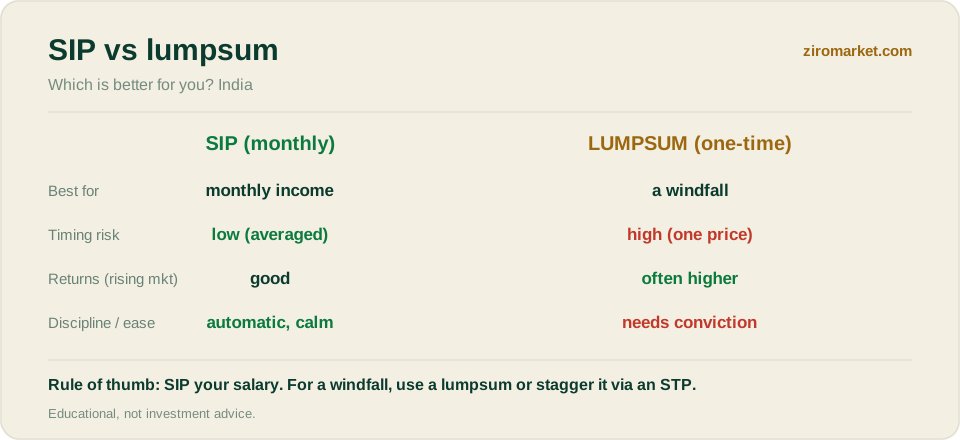
What is a SIP, and what is a lumpsum?
The two are just different ways to put money into the same fund. A SIP (systematic investment plan) invests a fixed amount automatically every month, while a lumpsum invests a large amount all at once. A SIP suits a salary earner saving month to month; a lumpsum suits a one-time amount like a bonus, a gift or a maturity payout.
Here is the comparison at a glance.
Which gives higher returns?
On pure maths, a lumpsum often wins in a rising market. Because a lumpsum puts all your money to work immediately while a SIP invests gradually, the lumpsum earns returns on the full amount for longer, and over long rising periods it tends to edge out the SIP. Markets rise more often than they fall, so time in the market favours getting fully invested sooner.
But that edge is fragile, and 2026 is a live example. Rs 1 lakh put into the Nifty 50 at its record close of 26,373.20 on 5 January 2026 was worth about Rs 88,800 at the 23,414.30 close on 21 September, before dividends. Splitting the same Rs 1 lakh into two halves, one at the January peak and one at the 2 April low of 22,182.55, would have averaged a cost near 24,100 and been worth about Rs 97,200 on the same date.
A monthly SIP will not hit the exact low, so real results sit between those rows, but spreading purchases cut the damage from buying at the top by more than half in this case. If the market falls soon after you invest a lumpsum, you feel the full drop at once, and that is the trade-off most people underestimate.

Which is lower risk?
The SIP wins clearly on risk, thanks to rupee cost averaging. Because a SIP invests a fixed amount every month, it buys more units when prices are low and fewer when they are high, averaging your cost and removing the need to time the market, as our how to read FII and DII activity piece notes is exactly the steady flow that has supported Indian markets. You never bet everything on one price.
The behavioural benefit is just as important. A SIP is automatic, so it keeps investing calmly through crashes and rallies alike, when a human might freeze or panic. That discipline, not the maths, is why SIPs have become the backbone of Indian retail investing.
So which should you choose?
Match the method to the money. If you invest from a monthly salary, a SIP is almost always the right answer; if you have a one-time windfall, the choice is between a lumpsum and staggering it in, and that depends on your horizon and on valuations. Valuations are one input: in mid-September 2026 the Nifty traded at about 19.5 times trailing earnings, below its five-year median near 22, as our is the Indian market overvalued piece discusses, which lowers but never removes the timing risk of deploying everything at once.
The two are not rivals. Many investors run a SIP from their salary and separately deploy windfalls, using each tool for the type of money it fits.
The middle path: an STP
There is a sensible compromise for a windfall. A Systematic Transfer Plan (STP) parks your lumpsum in a low-risk liquid or debt fund and moves it into equity gradually, capturing some averaging benefit without leaving the money idle. It is a popular way to invest a bonus or maturity amount when you like the averaging of a SIP but do not want to keep the cash sitting in a savings account.
Whichever you choose, the deciding factor is rarely the last percentage point of return. Match the method to the money, keep it going through the rough patches, and pick funds sensibly, as our how to choose a mutual fund guide sets out, and the habit itself will do far more for your wealth than winning the SIP-versus-lumpsum debate ever could.