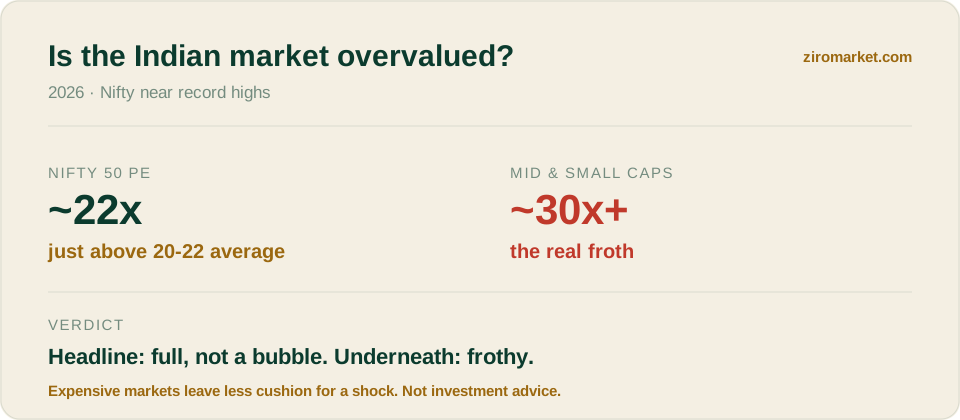
With the Nifty sitting near record highs, the question every investor is asking is whether the party has run ahead of the profits. The honest answer for 2026 is that the headline Indian market is fully valued rather than wildly overvalued: the Nifty 50 trades around 22 times earnings, a touch above its long-term average, while the real froth sits in mid-cap and small-cap stocks. So the market is expensive in places, but the Nifty itself is not in an obvious bubble.
Valuation is not a timing tool, but it tells you how much cushion you have if something goes wrong. Here is what the numbers actually say.
What does "overvalued" mean?
Overvalued means prices have outrun the earnings behind them. The simplest gauge is the price-to-earnings (PE) ratio, which is how many years of a company's current profit you are paying for upfront, as our what is PE ratio explainer covers. A high PE is not automatically bad, since fast-growing companies deserve higher multiples, but it does mean more of the price rests on future growth arriving.
The same logic scales up to an index. The Nifty 50 has its own PE, and comparing it to its own history tells you whether the market is priced for optimism, fear, or something in between.

Is the Nifty overvalued right now?
The large-cap market is full, not frothy. The Nifty 50 trades around 22 times trailing earnings in 2026, modestly above its long-term average of about 20 to 22 times, which signals confidence rather than mania. History suggests a Nifty PE above 25 reflects real exuberance and below 15 reflects fear; around 22 sits in the "priced for growth" zone.
Here is the rough picture across the market.
The takeaway is that the index most people track is fairly valued, while the risk is concentrated in the smaller end of the market. That distinction matters, because a headline "market at record highs" hides very different valuations underneath.
It also helps to compare across borders. India has long traded at a premium to other emerging markets because of its faster growth and deep domestic investor base, so a Nifty PE around 22 is partly that structural premium rather than pure excess. The real question is whether earnings keep growing fast enough to justify paying up for Indian shares versus cheaper markets elsewhere.
Where the real froth is
Mid and small caps are the stretched part. After years of heavy domestic inflows, many mid-cap and small-cap stocks trade at multiples far above both large caps and their own history, pricing in growth that may not materialise. That is where a valuation correction, if one comes, would likely bite hardest.
The reason is flows meeting a limited supply of quality. Steady SIP money has to go somewhere, and a lot of it has chased smaller companies, pushing some prices well beyond what earnings justify. Wide dispersion means there are still reasonably priced names, but the froth is real and concentrated.
What supports these valuations?
The supports are genuine, which is why the market has not corrected. Strong domestic inflows from SIPs and mutual funds, dovish Fed and RBI policy that makes equities more attractive than falling deposit rates, and a resilient economy with FY27 growth near 6.6% all underpin valuations, as our Indian stock market today wrap describes. As long as those hold, expensive can stay expensive.
But supports are also conditions. If domestic flows slow, if the RBI cannot cut, or if earnings disappoint, the same valuations that look justified today would look stretched, which is the whole risk of paying up in the first place.
What to watch
The first thing to watch is earnings growth. Full valuations are only justified if profits keep rising to grow into them, so the pace of earnings is the real test.
The second is the small and mid-cap end, where any unwind of froth would show up first and hit hardest.
The third is flows and policy. Steady SIP inflows and dovish central banks are holding the market up, so any change in either is the signal that valuations could come under pressure.
Risks to monitor
The clearest risk is a shock hitting a market with little cushion. A hawkish Fed, an oil spike, or heavy foreign selling would fall on full valuations, making any decline sharper than usual.
A second risk is the froth in small and mid caps unwinding, which has happened before and can be swift once sentiment turns.
The third is complacency. Being fully valued is not a crash signal, but it does mean the market is pricing in a lot of good news, so there is less room for disappointment. This is not a recommendation to buy or sell anything. This is general information, not investment advice.
So is the Indian market overvalued in 2026? Fairly full at the top, frothy underneath, and dependent on the flows and policy that have carried it this far. The Nifty near record highs is not a bubble by itself, but it is a market that has already priced in a good outcome, which is exactly when knowing where the froth sits, and where it does not, matters most.