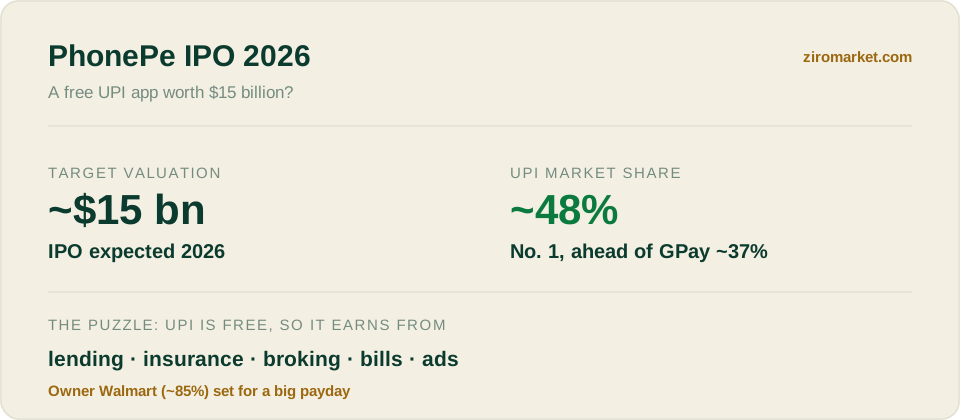
India's most-used payment app is about to test a strange proposition on the stock market. PhonePe is heading for a 2026 IPO at a valuation of around $15 billion, even though its famous feature, UPI payments, is completely free and earns it almost nothing. It would be one of India's largest new-age listings, and a huge payday for its owner, Walmart. The puzzle at its heart is simple: how is a free app worth that much?
The answer is the whole investment case. PhonePe is not really selling payments; it is selling access to hundreds of millions of daily users, and the financial products it can put in front of them.
What We Know
The listing has been years in the making. PhonePe moved its domicile to India in 2022 specifically to prepare for a domestic IPO, and 2026 is when it aims to go public, in what would rank among the country's biggest new-age offerings. It joins a busy pipeline of consumer-tech and fintech listings, following the interest around names like the Zepto IPO.
The scale is the headline. As India's largest UPI app, PhonePe processes a huge share of the billions of monthly UPI transactions, giving it a user base that few companies anywhere can match. That reach is exactly what the IPO is selling.
Walmart is the big shareholder. The US retail giant, which owns roughly 85% of PhonePe after it was spun out of Flipkart, is set for a significant return, making this listing a landmark for foreign investment in Indian tech as much as for PhonePe itself.
How PhonePe Makes Money
This is the question that decides the valuation. UPI person-to-person payments are free by design, so PhonePe earns almost nothing from the feature it is famous for, and it monetises its audience in other, higher-margin ways instead.
Here is where the money actually comes from.
The Valuation Question
A $15 billion tag is a lot for a company still investing heavily. PhonePe has been loss-making as it spends to grow, so investors are being asked to pay for future financial-services revenue, not current profit, the same leap of faith that quick commerce and other new-age names have demanded, as our quick commerce war 2026 coverage explored.
The bull case rests on scale and cross-selling. If PhonePe can convert even a fraction of its users into borrowers, insurance buyers and investors, the revenue could grow fast at high margins. The bear case is that monetising free-payment users is hard, competition from Google Pay is fierce, and regulation of UPI and lending could change the rules.
Why This Matters for Investors
PhonePe is a bellwether for Indian fintech. A successful IPO at a strong valuation would validate the whole model of building a business on top of free UPI, and set a benchmark for peers, while a weak reception would raise hard questions about how to value payment apps that give away their core product.
It is also a test of appetite for large new-age IPOs. After a run of consumer-tech listings, PhonePe's size makes it a gauge of how much investors will pay for growth and reach over near-term profit. The outcome will shape sentiment across the fintech space.
There is a bigger backdrop too. UPI now processes billions of transactions a month and has become the world's largest real-time payments system, so PhonePe is essentially a listed bet on the rails the entire country runs on. That is why global investors are watching: a stake in PhonePe is a stake in the digitisation of Indian money itself. The flip side is that a utility everyone depends on invites scrutiny, and any change to how UPI is priced or how digital lending is regulated would land on PhonePe first. For context, a $15 billion valuation would place it among the most valuable companies to list in India in years, rivalling established banks and IT firms despite being far younger and not yet consistently profitable.
Risks to Monitor
The clearest risk is profitability. PhonePe must show that its financial-services and commerce revenues can scale faster than its costs, or the valuation will look stretched.
A second risk is regulation. UPI economics, lending rules, and any move to charge or cap payment volumes could reshape the business overnight.
The third is competition. Google Pay is a powerful rival, and deep-pocketed players keep entering payments, which can cap PhonePe's pricing power. This is general information, not investment advice.
PhonePe's IPO puts a fascinating question to the market: what is a free app worth if hundreds of millions of people open it every day? Walmart is betting the answer is around $15 billion. Whether public investors agree will be one of the defining verdicts on Indian fintech in 2026.