The last big bank result is also the biggest. State Bank of India reports Q1 FY27 in early August, and with a profit near Rs 19,500 crore expected, the government-owned giant will complete the banking picture after a healthy run of private-bank results. The questions are familiar: can it hold its margin, keep bad loans falling, and grow lending, all at a scale no private bank can match?
SBI is a different animal from its private peers. It trades spread for size, earning a thinner margin on a vastly larger balance sheet, which is why it can post the sector's biggest profit while running one of its lowest margins.
What To Expect
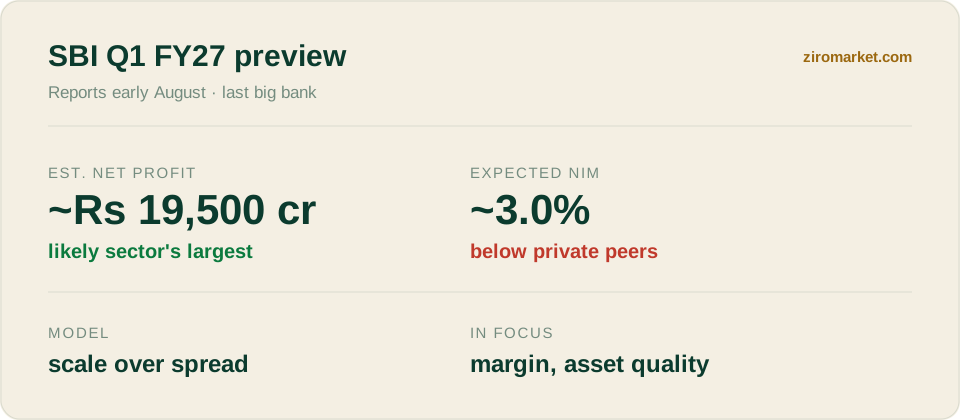
The headline should be a very large profit. Analysts broadly expect net profit near Rs 19,500 crore on net interest income around Rs 44,000 crore, which would likely make SBI the most profitable Indian bank by absolute rupees this quarter. That reflects the sheer size of its loan book rather than a high margin.
The margin is the number to watch. SBI's net interest margin is expected near 3.0 to 3.1%, well below ICICI Bank's 4.3% or HDFC Bank's 3.5%, because it lends heavily to lower-yielding corporate and government-linked borrowers. Whether it can defend even that level after the June rate cut is a key question.
Asset quality should keep improving. Gross non-performing assets are seen edging toward 2%, continuing the multi-year clean-up that has re-rated PSU banks, with credit growth expected in the low-to-mid teens. Steady provisions and a lower bad-loan ratio would confirm the health that the private banks already showed.
The deposit franchise is SBI's quiet advantage. With a deposit base of roughly Rs 55 lakh crore and the widest branch network in the country, SBI funds itself more cheaply than almost any rival, which partly offsets its lower lending yields. A strong low-cost deposit share, or CASA ratio, is what lets it run a thin margin and still earn the sector's largest profit, and any change in that funding mix is worth watching in the result.
Why This Matters for Investors
SBI completes the banking read. After healthy results from the private banks, a strong SBI print would confirm that the whole sector, private and public, is in good shape, which matters because financials are the heaviest part of the index. A clean sweep across ownership types is a powerful signal for the market.
The PSU angle is its own story. State-owned banks have re-rated over recent years as their asset quality improved, and SBI is the flagship of that trade, so its numbers shape sentiment across the public-sector banking space. Our private bank Q1 FY27 scorecard covers the private side that SBI now follows.
The rate cycle frames the outlook. With the RBI at 5.25% and expected to hold in early August, as our RBI August 2026 MPC preview explains, near-term margin pressure is limited, but SBI's large floating-rate corporate book makes it sensitive to any future cuts.
Market Reaction
The stock tends to move on margin and asset quality more than the headline profit. Because a large profit is expected, the market reaction will hinge on whether the margin holds near 3% and whether bad loans keep falling, the two numbers that decide the quality of the result.
As the single largest PSU stock and a heavyweight in the index, a strong SBI result would support the Nifty, while any disappointment on margins or slippages could weigh on the public-sector banking space. The timing, close to the RBI decision, means bank stocks will be doubly in focus.
Foreign and domestic flows matter here too, since SBI is a core holding for large funds, and institutional buying or selling around the result can amplify the move.
What Investors Should Watch
The first thing to watch is the margin. Whether SBI defends its roughly 3% NIM after the June rate cut is the key gauge of the result's quality.
The second is asset quality and slippages. Continued improvement in gross NPAs toward 2% would confirm the PSU clean-up is intact.
The third is credit growth. Low-to-mid-teens loan growth would show SBI is expanding its book while private banks compete hard for the same borrowers.
Risks to Monitor
The clearest risk is margin pressure. As a large lender to floating-rate corporate borrowers, SBI is exposed if rates fall further or deposit competition intensifies.
A second risk is asset quality surprises. Any unexpected slippages, especially in corporate or agricultural loans, would dent the improving narrative.
The third is the macro backdrop. High oil, a record-low rupee, and any risk-off shock could pressure financials along with the broader market. This is general information, not investment advice.
SBI's result is the fitting close to a strong banking season: the biggest balance sheet, the biggest profit, and the lowest margin, all at once. If it holds its spread and keeps cleaning its books, it will confirm that Indian banking, from the nimblest private lender to the state-owned giant, is entering the second half of 2026 on solid ground.