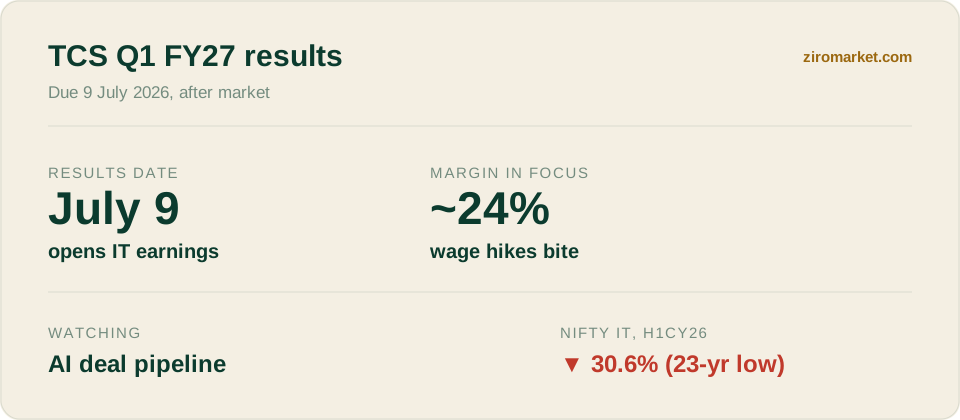
India's earnings season is open, and the first heavyweight delivered a steady beat. TCS reported Q1 FY27 net profit of Rs 13,349 crore on July 9, 2026, up about 5% year-on-year, with revenue rising 14% to Rs 72,275 crore, a defended operating margin of 24.0%, a Rs 12 interim dividend, and a strong $9.5 billion order book that included a marquee AI deal with SKF. After a brutal first half for IT stocks, the numbers offered reassurance rather than another scare.
The result lands at a charged moment, with the broader market rebounding from a sharp crash the day before, so TCS's tone on demand and AI carries extra weight for the sessions ahead.
What Happened
The headline numbers came in solid. Net profit rose about 5% year-on-year to Rs 13,349 crore, from Rs 12,760 crore a year earlier, while revenue grew 14% to Rs 72,275 crore, helped by a weaker rupee and steady demand. In constant-currency terms, the truer measure of underlying growth, revenue rose a more modest 0.4%, confirming that the recovery in demand is gradual rather than sharp.
Profitability held up where it mattered. The operating margin stood at 24.0%, exactly the level the market was watching, with a net margin of 19.2%, even as the quarter absorbed the annual wage hikes that dented profit by nearly 3% sequentially. Defending the margin through the wage-hike quarter was one of the day's most reassuring details.
The board also rewarded shareholders, declaring an interim dividend of Rs 12 per share, with a record date of July 15 and payment on July 31. The dividend signalled confidence in cash flows even in a demanding year for the sector.
Why This Matters for Investors
The order book is the standout. A total contract value of $9.5 billion, anchored by a marquee AI-led transformation deal with SKF, shows TCS is winning large deals rather than losing ground to the AI shift. Just as important, the company said its AI business has scaled to a $2.6 billion annualised revenue run rate, evidence that artificial intelligence is becoming a revenue line, not only a threat to the old labour-heavy model.
That matters for the whole sector. As the first major IT firm to report, TCS sets expectations for Infosys, Wipro, and HCLTech, and a steady result with a growing AI book eases some of the fear that hammered the Nifty IT index in the first half, when it fell about 30%. The read-through reaches every IT-heavy fund in the country, as flagged in our IT sector Q1 FY27 earnings preview.
For the broader market, a dependable TCS result is a steadying force after the previous session's crash, covered in our Indian stock market today wrap. It does not erase the geopolitical risk hanging over equities, but it removes one source of uncertainty at a nervous moment.
Market Reaction
The results came after market hours, so the full reaction will play out in the next session. The combination of a defended 24% margin, a large order book, and a growing AI business is the kind of mix that can lift sentiment toward the IT pack, especially after months of gloom.
The subdued constant-currency growth is the one number bears will point to, since it shows demand is still only inching higher. But with margins intact and deal wins strong, the overall picture is of a sector steadying rather than sliding, which is a meaningful shift in tone from the first half.
What Investors Should Watch
The first thing to watch is the AI trajectory. The $2.6 billion AI run rate and the SKF deal suggest TCS is converting the AI shift into revenue, so the pace of that growth is now a key metric each quarter.
The second is constant-currency revenue. Rupee tailwinds flatter the headline, so the underlying 0.4% constant-currency growth is the number to track for real demand momentum.
The third is the read-through to peers. Infosys reports on July 23, and its guidance will show whether TCS's steadiness is sector-wide or company-specific.
Risks to Monitor
The clearest risk is that demand stays soft. Constant-currency growth of 0.4% leaves little room for error if global clients cut technology budgets further.
A second risk is margin pressure from AI investment. Scaling the AI business and datacentre capabilities costs money, which could weigh on the 24% margin in coming quarters.
The third is the macro backdrop. A weaker global economy or a stronger rupee would both pressure an exporter like TCS, so the results do not make the stock immune to the wider risk-off mood. This is general information, not investment advice.
For a sector that spent the first half of 2026 as the market's biggest loser, TCS has offered a first, welcome sign that the worst may be priced in. The AI question is not settled in one quarter, but a $9.5 billion order book and a growing AI run rate are the clearest evidence yet that India's largest IT firm is adapting rather than fading.