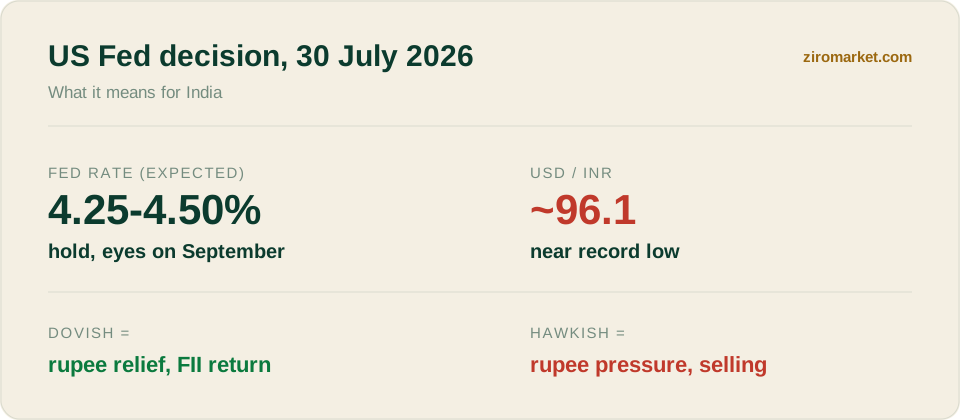
The most important number for Indian markets this week will be set in Washington, not Mumbai. The US Federal Reserve is expected to hold its benchmark rate at 4.25 to 4.50% on July 30, 2026, but the real focus is whether it signals a September cut, because that tone will drive the rupee, foreign flows and the RBI's room to move. For a rupee near a record low, the Fed's words matter as much as its action.
The setup is finely balanced. Weak US jobs data has revived hopes of cuts, but the Fed has stayed cautious on inflation, so the market is hanging on the guidance rather than the rate itself.
What To Expect
A hold is the base case, with the guidance doing the work. Most economists expect the Fed to keep its target range at 4.25 to 4.50%, its level for some time, while watching for any hint that a cut is coming at the September meeting. The decision itself may be a non-event; the tone will not be.
Weak data has shifted the debate. June's soft US jobs report, just 57,000 added with unemployment at 4.2%, revived expectations of cuts later in 2026, as our US jobs report 2026 coverage explained. If the Fed acknowledges the cooling labour market, markets will read it as dovish.
Inflation is the counterweight. The Fed has stayed cautious about declaring victory on prices, so a hawkish hold, one that stresses inflation risks and pushes back on cut expectations, remains possible. That gap between hope and caution is exactly what makes the guidance the market-moving part.
Markets have already priced a hold as near-certain, so the surprise, if any, lies in the framing. Traders will parse the statement wording, the vote split, and the chair's press conference for how firmly a September cut is on the table. A single shift in phrasing about the labour market or inflation can move the dollar more than the unchanged rate itself, which is why the reaction can be sharp even when the decision is exactly as expected.
Why This Matters for India
The rupee is the clearest channel. Because India's currency is near a record low around 96, a dovish Fed that weakens the dollar would give the rupee real relief, while a hawkish one would deepen the pressure, as our rupee vs dollar today page tracks. The rupee often makes its sharpest moves in the hours after a Fed decision.
Here is how the main outcomes would likely play out for India.
Foreign flows follow the dollar. Higher US rates pull money toward dollar assets and out of emerging markets, so a dovish Fed could slow the foreign selling that has weighed on India through 2025 and 2026, a dynamic explained in our how to read FII and DII activity guide. A hawkish surprise would do the opposite.
What It Means For The RBI
The Fed shapes the RBI's room to move. The gap between US and Indian rates influences the rupee, so if the Fed starts cutting, the RBI gains more freedom to ease later in 2026 without weakening the currency further. With the RBI having cut to 5.25% in June and expected to hold in early August, as our RBI August 2026 MPC preview explains, the Fed's path feeds directly into its next decisions.
That link is tighter than usual now. With oil elevated, the rupee at record lows, and inflation above target, the RBI has little room to cut on its own, so a dovish Fed would be one of the few things that could open the door to more easing at home.
What Investors Should Watch
The first thing to watch is the language on September. A clear hint that a cut is coming would be the dovish trigger that lifts risk assets and eases the rupee.
The second is the tone on inflation. If the Fed stresses price risks and pushes back on cuts, expect a stronger dollar and pressure on Indian markets.
The third is the rupee's immediate reaction, the fastest read on how the market has interpreted the decision, followed by foreign flows over the following sessions.
Risks to Monitor
The clearest risk is a hawkish surprise. If the Fed sounds firmer on inflation than expected, the dollar could strengthen and the rupee could test new lows, prompting foreign selling.
A second risk is a policy misread. Markets can overreact to a single word in the statement, so the initial move may reverse once the details are digested.
The third is the local overlap. The decision lands alongside monthly expiry and just before the RBI, so the reaction in India could be amplified by domestic events. This is general information, not investment advice.
For all the focus on Indian earnings this month, the market's next move may be decided abroad. A dovish Fed would hand the rupee and Indian equities a welcome tailwind into August; a hawkish one would remind investors that with the currency at record lows, India is still at the mercy of the dollar. By Thursday morning in Mumbai, the market will know which it got.