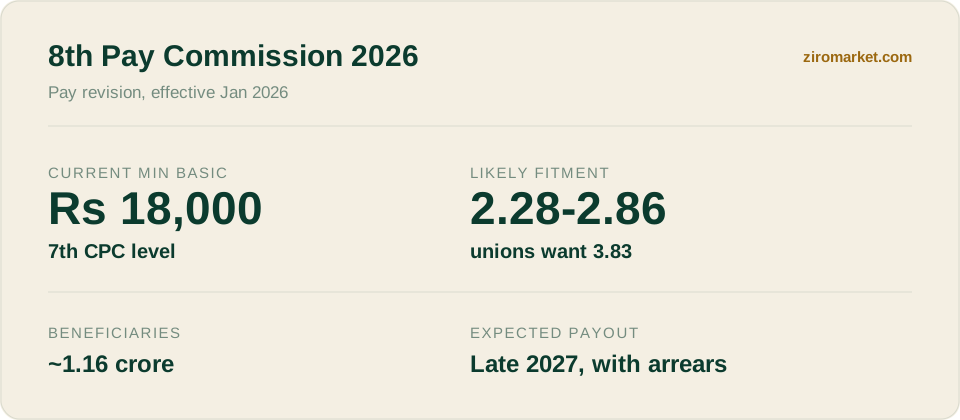
Millions of central government employees are watching one number, and nine months after the commission was constituted it still does not exist. The government told the Lok Sabha on August 10, 2026 that the 8th Pay Commission has not submitted any recommendations, and no fitment factor, minimum basic pay or hike percentage has been announced, with estimates running from about 1.83 to a union demand of 3.83 and the money unlikely to land before late 2027. The revision applies from January 1, 2026, so whatever is decided comes with arrears attached.
That gap between the effective date and the payout is the crux of the story: the raise is coming, but slowly, and how big it is remains genuinely undecided.
What Is Happening
The commission is still in its listening phase, and the calendar says it will stay there for a while. Constituted on November 3, 2025 under chairperson Justice Ranjana Prakash Desai, the 8th CPC has scheduled stakeholder visits to Jaipur on August 31 and September 1, Chennai on September 7 and 8, Puducherry on September 9, and Chandigarh from September 16 to 18, 2026, following earlier rounds including Lucknow in June. This is the stage where demands are logged, before any recommendation is drafted.
That timetable is the real news for anyone tracking their own salary. A commission still booking consultation venues in September 2026 is not weeks away from a fitment factor, which is why the Lok Sabha reply on August 10 stated plainly that nothing has been decided on pay, allowances or pensions.
Employees have not waited quietly. Leading unions have pushed for a fitment factor as high as 3.25 to 3.83, well above the 2.57 used by the 7th Pay Commission, along with a 7% annual increment instead of the current 3% and more generous leave encashment at retirement. The government has given no number, and independent estimates cluster lower, in the 2.28 to 2.86 band.
In the meantime, the Dearness Allowance continues to rise separately. The Union Cabinet approved an additional 2% DA, taking it to 60% of basic pay effective January 1, 2026, which cushions employees while the larger revision works its way through the system.
Why This Matters
The fitment factor is where the whole debate lives. Here is how different multipliers translate the current Rs 18,000 minimum basic pay.
The distance between the low and high scenarios is more than Rs 25,000 a month at the entry level, which is why the number is contested so fiercely. The final figure sets the base for allowances and pensions too, so it multiplies through the entire pay structure.
Beyond individual pay packets, this is a macro event. A pay revision reaching over a crore households tends to lift spending on cars, two-wheelers, consumer durables, and housing, the same consumption bump that followed the 7th Pay Commission. That is why the payout timeline matters for the wider market, not just for government staff.
What To Watch
The first thing to watch is the fitment factor itself, once the commission signals a number. It is the single variable that decides whether this is a modest revision or a transformative one, and every other allowance flows from it.
The second is the timeline. The report is expected around May 2027, with Cabinet approval later that year, so the arrears from January 2026 could add up to a large one-time payout when disbursement finally happens.
The third is the fiscal math. A higher salary and pension bill widens government spending, so the size of the award will be weighed against the deficit, which can influence bond yields and the government's borrowing plans, themes tied to our Union Budget 2026 highlights.
Risks to Monitor
The clearest risk is disappointment on the fitment factor. If the final number lands near the lower end of estimates, the take-home increase after adjusting for the DA already merged could feel smaller than employees expect.
A second risk is delay. Pay Commission timelines can slip, and any slippage pushes the payout and the consumption boost further out, though it also grows the arrears.
The third is the fiscal trade-off. A generous award lifts consumption but strains public finances, so the government may phase or temper the payout to manage the deficit. This is general information, not investment advice.
For now, the 8th Pay Commission is a promise with the price tag still blank. The effective date is set, the beneficiaries are counted, and the demands are on the table, but the one number that decides how much more than a crore families take home is exactly the number no one has yet agreed on.