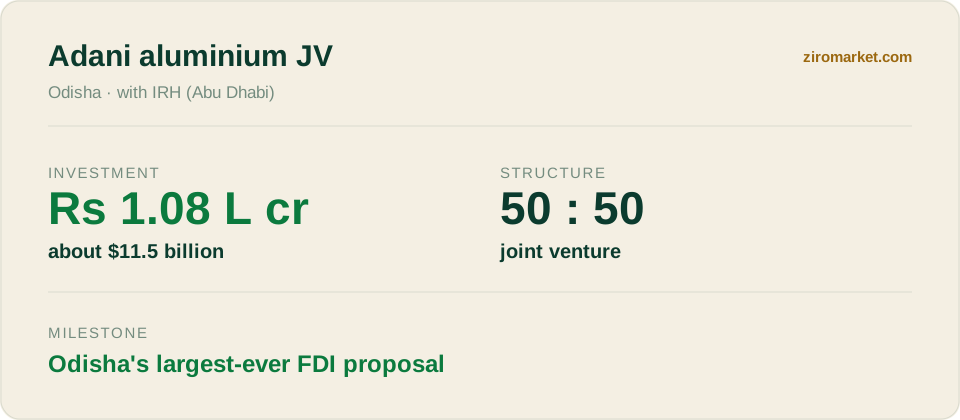
India just landed one of its biggest industrial commitments of the year. Adani Enterprises and International Resources Holding (IRH) have signed a memorandum of understanding with the Odisha government to build an integrated aluminium project worth about Rs 1.08 lakh crore, or roughly $11.5 billion, set to become the state's largest-ever foreign direct investment. The two partners will hold the greenfield project as a 50:50 joint venture.
The deal marks a major push by the Adani group into metals, and a vote of confidence from a Gulf investor in India's industrial story. At this scale, it is as much an infrastructure statement as a business one.
What Happened
The agreement is a headline-grabbing commitment. Adani Enterprises and IRH, an Abu Dhabi-based investor, signed an MoU with the Odisha government to develop an integrated greenfield aluminium project as a 50:50 joint venture, with a proposed investment of about Rs 1.08 lakh crore. As an integrated project, it would span the full value chain, from raw material processing to finished aluminium.
The scale is what stands out. At roughly $11.5 billion, the project would be the largest FDI proposal Odisha has ever seen, in a state already known as a magnet for metals and mining investment. Odisha's large reserves of bauxite, the ore aluminium is made from, and coal for power make it a logical home for an energy-intensive aluminium plant.
For Adani, it is a significant expansion into metals, adding to a group already spanning ports, energy, airports, and infrastructure. The partnership with a Gulf investor brings in foreign capital and shares the heavy funding a project of this size requires.
Why This Matters for Investors
A commitment this large signals ambition and confidence. Integrated aluminium plants are among the most capital-intensive industrial projects, so a Rs 1.08 lakh crore investment reflects a long-term bet on demand for the metal, driven by construction, autos, packaging, and the energy transition, where aluminium is used in solar and electric vehicles.
For the Adani group, the move deepens its push into metals and heavy industry, diversifying beyond its established infrastructure businesses. It also underlines the group's ability to attract large foreign partners, a signal of restored confidence after the legal cloud that hung over it earlier.
For Odisha and India, a project of this scale means jobs, supporting infrastructure, and a boost to the domestic metals base. It fits a broader trend of large private and foreign capital flowing into Indian manufacturing and resources.
Market Reaction
Adani Enterprises featured among the stocks in focus on the news, having been among the market's top gainers around the announcement. Large project announcements often lift sentiment on a stock by signalling growth, even though the earnings from such projects lie years in the future.
The deal also sits alongside other Adani group moves, including Adani Energy Solutions' board approving a fundraise of up to Rs 10,000 crore, pointing to an active phase of expansion and capital raising across the group. You can follow the wider market on our Indian stock market today page.
What Investors Should Watch
The first thing to watch is the move from MoU to firm commitments. The key milestones are land, clearances, financing, and a final investment decision, which turn a memorandum into a real project.
The second is funding. A project of this size needs enormous capital, so how the JV finances it, through equity, debt, or partner contributions, matters for the parent companies' balance sheets.
The third is aluminium demand and prices. The economics of an integrated plant depend on the metal's price over the long run, so global aluminium trends and the pace of the energy transition are key to the project's returns.
Risks to Monitor
The clearest risk is execution. Mega-projects can face delays, cost overruns, and clearance hurdles, and the gap between an MoU and a producing plant is long and uncertain.
A second risk is funding and leverage. Large capital commitments can strain balance sheets, especially if metal prices weaken during the build, so the financing structure is worth watching closely.
The third is commodity cyclicality. Aluminium prices move with the global economy, so a downturn could pressure the project's economics even after it is built. This is general information, not investment advice.
A Rs 1.08 lakh crore aluminium venture is a bold statement of intent, both for the Adani group's metals ambitions and for India's pull on large foreign capital. The MoU is the easy part, though. Whether it becomes Odisha's biggest FDI in practice will depend on the years of building, funding, and market cycles that lie ahead.