India's largest renewable developer has passed a threshold no Indian company had reached before. Adani Green Energy surpassed 20 GW of operational renewable capacity on 1 July 2026, a figure equal to roughly 14% of India's utility-scale solar capacity and about 12% of utility solar and wind combined, reaching it within a decade of commissioning its first project at Kamuthi, Tamil Nadu in 2016.
The more striking detail is how it got there. Most of that capacity was built on empty land rather than bought.
Why greenfield is the harder number
There are two ways to own 20 GW of renewable capacity. You can buy operating projects from other developers, which is fast and expensive, or you can build them, which is slow and also expensive.
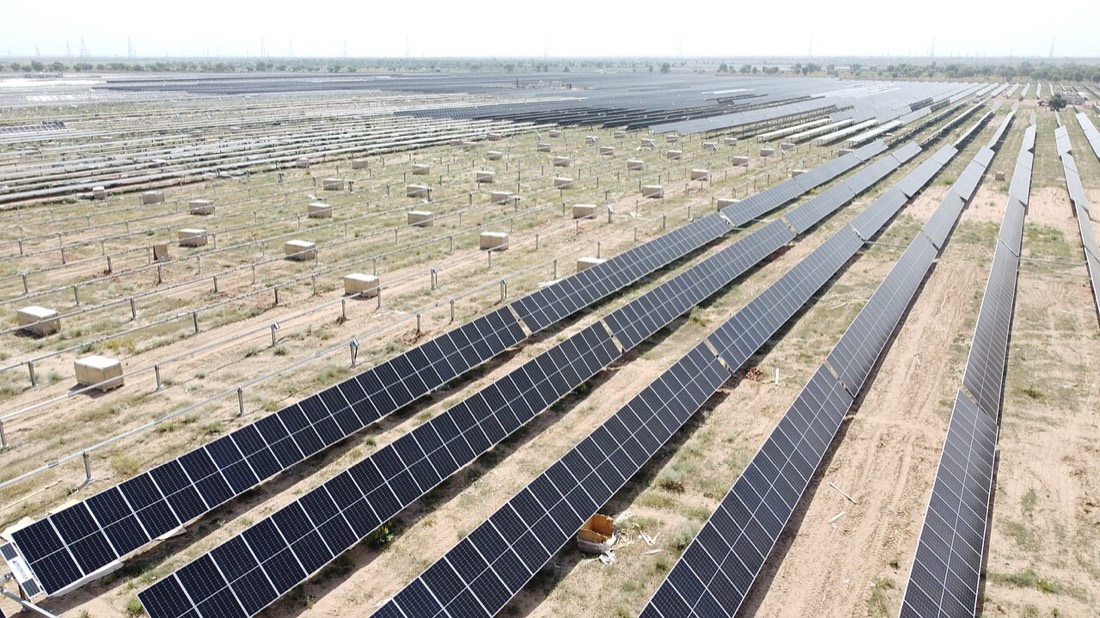
Adani Green reached this scale predominantly through greenfield development, meaning land acquisition, transmission connectivity, construction and commissioning done in-house rather than purchased as running assets. That distinction matters because it is the part competitors find hardest to replicate. Buying a solar farm requires capital. Building 20 GW requires land at scale, grid connections approved years in advance, and a supply chain that does not stall.
The pace has accelerated rather than settled. The company added a record 5 GW in FY26 alone, roughly a quarter of everything it operates today, in a single year.
Khavda is the whole strategy in one place
The centrepiece sits on barren land in Kutch, Gujarat. Khavda is planned at 30 GW across 538 square kilometres, and about 9.5 GW of solar has been commissioned there, more than 30% of the planned capacity.
That single site, when complete, would be larger than the company's entire current operating fleet. It is also the clearest illustration of why land and transmission, not panels, are the binding constraints in Indian renewables. Barren land at that scale exists in very few places, and the grid infrastructure to evacuate 30 GW from one location has to be built alongside it.
The part most coverage skips: storage
Capacity headlines are the easy number. Storage is the one that decides whether the capacity is useful.
Solar generates at midday while Indian electricity demand peaks in the evening, so beyond a certain penetration, adding solar produces surplus power the grid cannot absorb. Storage converts variable generation into something closer to dispatchable supply, and it is the difference between a renewable grid and a renewable headline.
Adani Green currently operates roughly 3,551 MWh of battery storage. The plan is to add 10 GWh during FY2026-27 and reach 50 GWh over five years, which is a far steeper build than the generation ramp and, in engineering terms, a harder one.
What to watch
The first is the annual run rate. Reaching 50 GW by 2030 means adding roughly 30 GW in about four years, more than the company built in its first decade. Whether the 5 GW achieved in FY26 becomes a floor or a peak is the single most informative number in future filings.
The second is storage delivery against the 10 GWh FY27 commitment, because storage is where the technical and cost risk concentrates.
The third is funding cost. Renewable projects are capital-intensive and long-dated, so the cost of debt directly determines project returns, which makes the current global rate environment more relevant to this business than to most, a backdrop our Fed dot plot explainer covers. The wider group's capital position is covered in our Adani Group FY26 capex analysis.
Risks to monitor
The second risk is concentration. A very large share of future growth sits at one site in one state, which concentrates land, transmission and weather risk in a way a distributed portfolio would not.
The third is that the 2030 target requires sustained access to capital at workable rates across four more years, and that condition is outside the company's control. This is general information, not investment advice.
The number worth sitting with is not 20 GW. It is that one company now accounts for roughly one in seven units of India's utility-scale solar capacity, and intends to more than double that within four years.