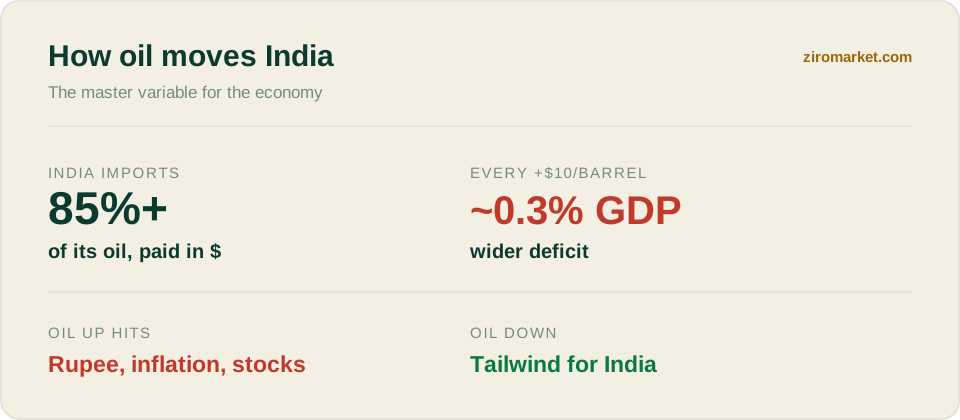
If you had to pick one price that decides how the Indian economy feels in any given month, it would not be the Nifty or even the rupee. It would be crude oil, because India imports more than 85% of the oil it burns and pays for it in dollars, which makes oil the master variable behind inflation, the currency, the trade deficit, and the fortunes of entire sectors. When crude moves, everything downstream moves with it.
The July 2026 flare-up made the point vividly: after the US struck Iran and Brent jumped to near $76 a barrel, the rupee slipped, stocks fell, and inflation worries returned, all in a single session. To see why one commodity carries so much weight, follow the chain.
Update, August 2026: this is live again. Brent traded near $105.80 a barrel on 17 September 2026, having crossed $100 on 9 September, after new US sanctions on Iran, and the daily level is tracked on our crude oil price today page.
The five channels oil flows through
Oil does not hit the economy in one place; it seeps in through several at once. Each channel amplifies the others, which is why a big oil move is felt so widely.
The import bill is where it starts. Oil is India's single largest import, so a higher price forces the country to spend more dollars abroad, widening the current account deficit. A rough rule of thumb is that every $10 per barrel rise adds roughly 0.3 to 0.4% of GDP to the deficit, a meaningful drag for a country that already runs a trade gap.
From the deficit to your wallet
The second channel is the rupee, and it follows directly from the first. Buying more oil means buying more dollars, which pushes the rupee down, as it did when crude spiked in July 2026 and the currency slipped toward 95.2, covered on our rupee vs dollar today page. A weaker rupee then makes every other import costlier too, feeding a second round of price pressure.
That leads to inflation, the channel households feel most. Petrol and diesel get pricier, and because almost everything in India moves by road, transport costs lift the price of food and goods across the board. Oil-linked products like paints, tyres, and plastics see input costs climb as well. Rising inflation can force the Reserve Bank of India to hold interest rates higher for longer, which slows growth, tying the oil price directly to monetary policy.
Government finances are the fourth channel. When oil rises, the government faces a hard choice: absorb the cost through lower fuel excise and fatter subsidies, which strains the budget, or pass it to consumers and risk public anger. That trade-off is why pump prices can stay frozen for months, as explained in our petrol and diesel price today page, with oil companies absorbing the swings in between.
Winners, losers, and why it cuts both ways
The fifth channel plays out in the stock market, where an oil move reshuffles winners and losers fast. Upstream producers like ONGC and Oil India gain when crude rises because their revenue climbs with the price, while heavy oil users suffer, including airlines paying more for jet fuel, paint and tyre makers, logistics firms, and parts of the chemicals sector. That is why oil and gas and consumption stocks often move sharply on oil headlines, as seen in our Indian stock market today coverage.
The thing to remember is that every one of these channels runs in reverse when oil falls. Cheaper crude narrows the deficit, supports the rupee, cools inflation, eases the fiscal burden, and lifts oil-using sectors, which is why India is one of the biggest winners whenever global oil slides. The country's fortunes are, to an unusual degree, a bet on the price of a barrel it mostly does not produce.
That dependence is also why events like the 2026 Strait of Hormuz crisis matter far beyond the Gulf. A conflict near a narrow shipping lane can, within hours, raise the cost of an Indian family's groceries, weaken their currency, and dent their mutual funds, all through the single, quiet number that is the price of crude.