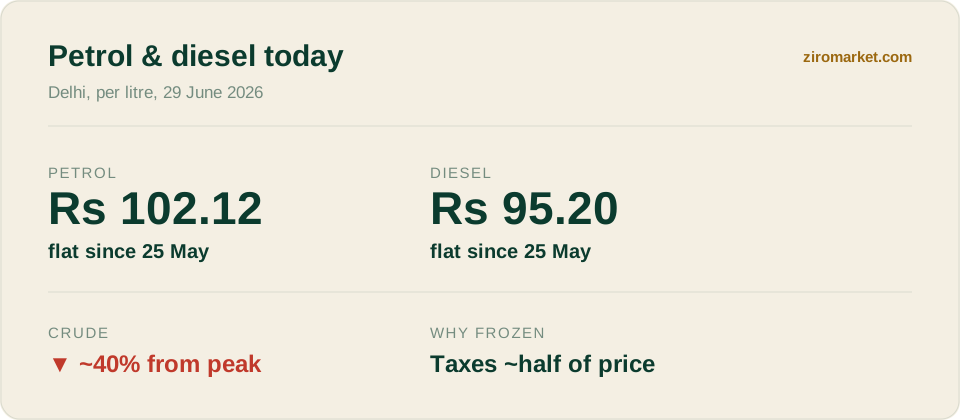
Crude oil has been on a four-month rollercoaster, but your fuel bill has sat perfectly still. Petrol costs about Rs 102.12 a litre and diesel about Rs 95.20 in Delhi as of 1 October 2026, unchanged since 25 May through a crude round trip from near $109 in mid-September down to about $97 and back up to $102.31 on a fresh Gulf escalation report, because taxes and fixed costs, not crude, dominate the pump price. It is the question millions of drivers ask every time oil makes headlines: if crude keeps moving, why does petrol not?
The short answer is that the crude oil price is only one slice of what you pay. The rest is tax, dealer margin, and the oil companies' own profit, and those do not move just because crude does.
Pump prices are reviewed daily including weekends, and remained unchanged as of 2 October 2026, more than four months since the last revision.
Petrol and Diesel Price by City
Pump prices vary across India mainly because each state charges its own VAT on top of a similar base price. Here are the rates as of 1 October 2026.
The gap between Delhi and Kolkata, more than Rs 11 a litre on petrol, is almost entirely down to state taxes, since the underlying fuel costs the oil companies roughly the same in both cities.
Why Pump Prices Stay Flat
The disconnect between crude and the pump is by design. Roughly half of what you pay for petrol is central excise duty and state VAT, with dealer commission and the oil companies' margin on top, leaving the crude oil cost as just one component. So neither a crash nor a spike in crude translates into anything close to the same move at the pump.
This is why the freeze has survived a genuinely wild few months. When crude fell, oil marketing companies like Indian Oil, BPCL, and HPCL rebuilt margins rather than cutting prices. When crude jumped to nearly $109 on the Hormuz disruption and the Saudi pipeline shutdown, those same companies absorbed the higher cost rather than raising pump prices, and now that Brent has jumped back to about $102 on a fresh Gulf escalation report, the freeze has simply continued, holding since the last revision on 25 May, when petrol was raised about Rs 2.61 and diesel about Rs 2.71 a litre.
The crude swings are showing up in company margins, just not at the pump. You can track the raw input on our crude oil price today page, and the wider market reaction in our Indian stock market today wrap.
Why This Matters
For households, fuel is a big and visible cost, and a frozen pump price can feel like either a missed saving or a lucky escape depending on which way crude is moving. When crude fell, the benefit flowed to the government and oil companies rather than drivers; when crude spiked, that same buffer shielded drivers from an immediate increase. It has now cut both ways within the same four months.
For the economy, the bigger swing factor remains the direction of crude. A sustained rise in oil, driven by any return of Strait of Hormuz tension, would widen India's import bill and pressure the rupee even if pump prices stay frozen, so the strain shows up in the wider economy before it reaches the fuel station.
What To Watch
The first thing to watch is crude oil and whether this week's spike to $102 holds or fades. If oil falls back toward $97 or lower for several weeks, the case for a cut strengthens slightly, though oil companies have shown no urgency to move either way.
The second is any government move on excise duty. A duty change is the fastest way to move pump prices in either direction, and governments use it to manage inflation, so policy signals matter as much as the crude price.
The third is the rupee. Since India imports oil in dollars, a weaker rupee makes the landed cost of fuel higher even at the same crude price, adding to the pressure when oil is rising.
The Bigger Picture
Daily price revision was meant to link pump prices closely to global crude, but in practice prices have now gone more than four months without moving at all. For consumers, the lesson is that a crude move rarely means an instant change at the pump, because the tax and margin layers act as a buffer in both directions.
That buffer is exactly what the last four months have shown. Crude spiked toward $109 and pump prices did not rise; it eased back to $97 and they did not fall; it has now jumped again to about $102 and, once again, nothing moved at the pump. The system smooths the extremes, so neither the spike nor the retreat passes through. With oil back in a volatile patch, the question has quietly shifted from how long the freeze can hold under pressure to whether it ever breaks at all.