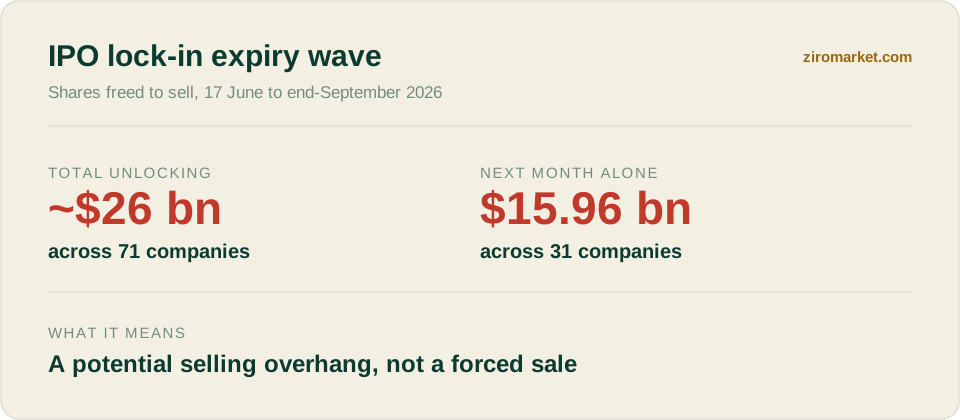
A quieter risk is building beneath India's cheerful market, and it has a date attached. Roughly $26 billion of shares from 71 recently listed companies become free to sell as IPO lock-ins expire between June 17 and the end of September 2026, with about $15.96 billion across 31 companies eligible in just the next month. It is a wave of potential supply that could test some of the year's hottest new listings.
This is not a crash signal. A lock-in expiry creates the option to sell, not the obligation. But when a large block of shares suddenly becomes tradable in a short window, the extra supply can weigh on prices, and investors holding recently listed stocks should know it is coming.
What Happened
After an IPO, the big early backers cannot sell their shares straight away. They are bound by a lock-in, a period designed to stop a rush of selling right after listing. In India, anchor investors are often locked in for 30 to 90 days, while promoters and other pre-IPO holders are locked in for longer. When the clock runs out, those shares become eligible to trade.
A large batch of these lock-ins now expires in a concentrated stretch. About $26 billion of shares across 71 companies becomes free between June 17 and end-September 2026, the legacy of India's heavy IPO activity over the past year. The most immediate chunk is the next month, when roughly $15.96 billion across 31 companies becomes eligible to sell.
The timing is notable because it overlaps with a still-busy primary market, including fresh issues like the Turtlemint IPO opening June 19. New listings competing for money while old lock-ins free up adds to the supply of shares chasing the same pool of investor capital.
Why This Matters for Investors
The core idea is supply and demand. When more shares become available to sell, prices can soften unless there is matching demand to absorb them, and a $26 billion wave is a meaningful increase in tradable supply over a few months. For specific recently listed stocks, an expiry can create a temporary overhang that caps gains or triggers a dip.
The key nuance is that eligibility is not the same as selling. A lock-in expiry simply removes the restriction, and whether prices actually fall depends on how many holders choose to sell. Financial investors like venture capital and private equity funds are often motivated sellers once free, since they invested to eventually exit, whereas promoters may hold on. So the impact varies sharply depending on who owns the unlocking shares.
For the broader market, the wave is a moderating force rather than a catastrophe. India's main indices are being driven by oil, the Iran peace deal, and the Fed, and the lock-in expiries are a stock-specific and sector-specific factor layered on top. The effect concentrates in recently listed names rather than the blue-chip heavyweights that move the Nifty and Sensex.
Market Reaction
There is no single market-wide reaction to watch, because lock-in expiries play out company by company over weeks. The pattern to look for is weakness in specific recently listed stocks around their individual expiry dates, especially those with large financial-investor holdings. The clearest tell is unusual selling volume in a recently listed stock as its lock-in date passes.
So far the broader market has shrugged off the looming supply, with the Nifty closing above 24,000 for a fourth straight session on June 18. The lock-in wave is a slow-moving factor that tends to show up in individual share prices rather than in index-level moves.
What Investors Should Watch
The first thing to watch is the expiry calendar for any recently listed stock you hold. Knowing the date a large block becomes free lets you anticipate potential pressure rather than be surprised by a sudden dip in volume and price.
The second is the holder profile. Check whether the unlocking shares belong to promoters, who may hold, or to financial investors seeking an exit, who are more likely to sell. The selling risk is far higher when motivated financial backers dominate the unlocking block.
The third is how the market absorbs the early expiries. The reaction to the first wave of unlocks over the next month will signal how much appetite there is to soak up the supply, setting the tone for the larger expiries through September.
Risks to Monitor
The main risk is concentrated selling in weaker or richly valued recent listings. Stocks that ran up sharply after listing, without fundamentals to match, are the most exposed when early investors get their first chance to cash out.
A second risk is the interaction with fresh IPOs. With new issues still launching, the combined supply of new shares and unlocked shares competes for the same investor money, which can strain demand and pressure prices across the recently listed segment.
The third risk is sentiment. If a few high-profile stocks fall hard around their expiries, it could sour the mood toward recently listed companies broadly, even those with strong fundamentals, creating a temporary chill in the IPO ecosystem.
The lock-in wave is a reminder that an IPO does not end on listing day. The real test of a newly public company often comes months later, when its early backers are finally free to sell and the market finds out how many of them want to stay.