India's biggest carmaker leaned on new strengths to grow. Maruti Suzuki reported Q1 FY27 net profit of about Rs 4,200 crore, up roughly 8% year-on-year, as record exports and a richer SUV mix offset a still-soft small-car market. For the sector's bellwether, it was a quarter that showed where the auto growth is coming from now, and it is no longer cheap hatchbacks.
The result matters beyond Maruti. As the largest carmaker and a barometer of consumer demand, its numbers are a health check on how confident Indian households feel about spending.
What Happened
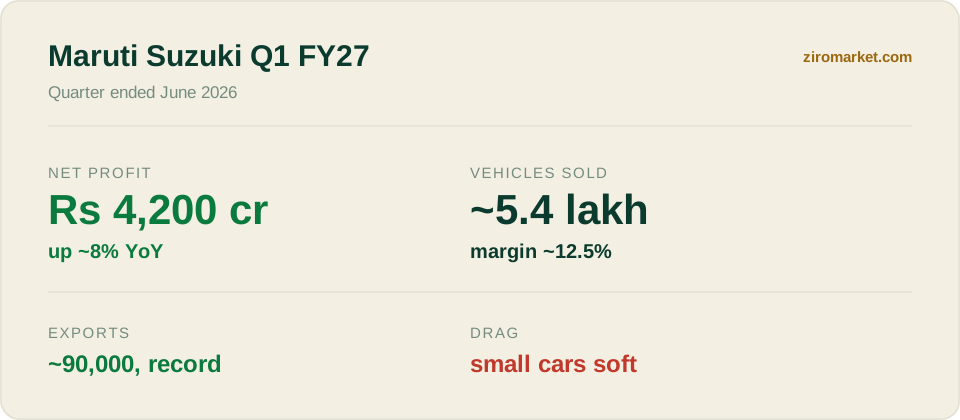
The headline numbers were solid. Net profit of about Rs 4,200 crore rose roughly 8% year-on-year on revenue near Rs 40,500 crore, with total volumes of about 5.4 lakh units, up around 4%. In a demand environment that has been uneven, mid-single-digit volume growth with an 8% profit rise reflects a better sales mix rather than a broad surge.
The mix was the real story. Small-car volumes, Maruti's traditional base, stayed weak as budget buyers held back, but higher-margin SUVs and record exports carried the quarter. That shift toward pricier vehicles is why the operating margin held near 12.5% even without a small-car recovery.
Exports were the standout. At a record of around 90,000 units, up about 15%, overseas sales have become a genuine growth engine, helped by Maruti's expansion across Africa, Latin America and the Middle East, and by a weak rupee that makes its cars more competitive abroad.
The Volume Picture
Here is where the vehicles went in the quarter.
Why This Matters for Investors
Maruti is a read on the consumer economy. Because it sells about 40% of India's cars, its volumes and mix signal how healthy household spending and rural demand are, which matters far beyond the auto sector. A shift toward SUVs and exports, with small cars soft, tells a story of uneven consumption: the affluent buyer is active, the budget buyer cautious.
The export growth is strategically important. It reduces Maruti's dependence on a soft domestic small-car market and turns the weak rupee into an advantage, since a cheaper rupee lifts the value of overseas earnings, as our rupee vs dollar today page tracks. Diversified demand makes the earnings more resilient.
For the market, the timing adds to the read. Auto results land as the earnings season winds down and the market consolidates ahead of policy events, as our Indian stock market today wrap describes, so a solid Maruti print supports sentiment in the consumption and auto names.
Market Reaction
Auto stocks tend to move on volumes and margins more than the headline profit. A record export number and a held margin are the kind of details that reassure investors, even with small cars soft, so the market's focus will be on whether the SUV and export momentum can persist.
Analysts will parse the demand commentary closely, especially on rural recovery and the small-car segment, since those decide whether Maruti's growth broadens or stays narrow. The outlook on input costs and the electric eVX ramp will also shape the medium-term view.
The read-across matters for peers. Tata Motors, Mahindra and the two-wheeler makers report around now too, and Maruti's mix-led quarter sets a template the market will compare them against.
What Investors Should Watch
The first thing to watch is the small-car recovery. Whether budget buyers return is the swing factor for Maruti's domestic volumes, since SUVs and exports cannot carry growth forever.
The second is exports. Sustaining the record pace would confirm a durable second growth engine and reduce reliance on the domestic cycle.
The third is margins and input costs. Holding near 12.5% through a soft small-car quarter shows discipline, so the trajectory from here is worth tracking.
Risks to Monitor
The clearest risk is a prolonged small-car slump. If budget demand stays weak, domestic volume growth could stall despite the SUV and export strength.
A second risk is input costs and the rupee. Costlier commodities or a sharp currency move could pressure margins, though a weak rupee currently helps exports.
The third is the broader consumption cycle. A weak monsoon or slowing rural demand would hit auto sales along with other consumer sectors. This is general information, not investment advice.
Maruti's quarter shows an auto leader adapting to where the demand actually is: up-market at home and increasingly abroad. The soft small-car market is a real drag, but record exports and a richer mix proved the company can grow profit without it. Whether that is enough depends on the budget buyer coming back, and on the sector holding up as the market turns from earnings to the Fed and the RBI.