Solana has completed one of crypto's great comebacks, and now it wants more. After nearly dying in the 2022 FTX collapse, Solana rebounded to become the most credible challenger to Ethereum, trading near $150, and the question for 2026 is whether the fast, cheap blockchain can keep climbing or has run into its limits. It is the coin that best captures crypto's speculative, consumer side.
Solana's pitch is simple: it is fast and cheap where Ethereum is slow and expensive. That has won it users and a fervent following, but it comes with its own baggage.
Why Solana Rose
The recovery was about resilience. When FTX, a major Solana backer, collapsed in 2022, many wrote SOL off, but the network kept running, developers and users stayed, and its speed and near-zero fees pulled in a wave of consumer apps, trading and meme coins. Surviving the worst-case scenario is what rebuilt its credibility.
Activity became its calling card. Solana handled huge transaction volumes cheaply, making it a natural home for high-frequency use cases that Ethereum's fees priced out, from meme-coin trading to payments, as our Solana ecosystem coverage detailed. That real usage, not just speculation, underpinned the rebound.
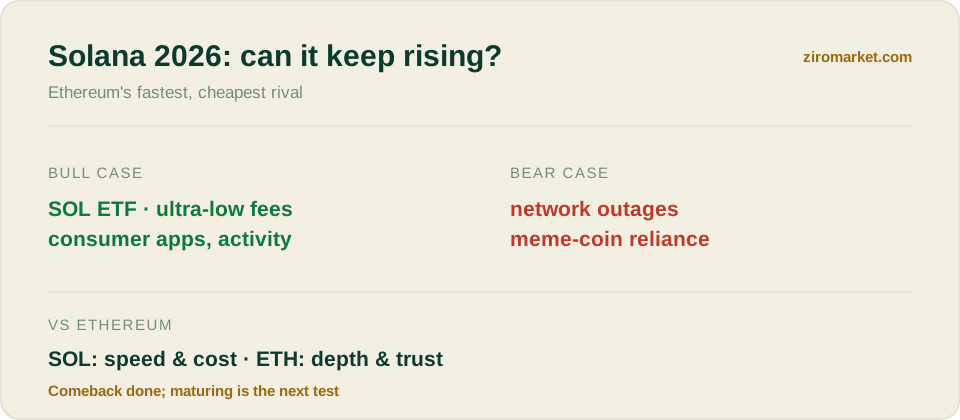
The Bull Case
The catalysts are concrete. The biggest would be a spot Solana ETF, made more plausible by clearer US crypto rules, which could bring the kind of institutional money that spot ETFs channelled into bitcoin. For a coin with a strong retail base, institutional access would be a step change.
Speed and cost are the durable edge. As more consumer apps, payments and stablecoins look for a cheap, fast chain, Solana is the obvious candidate, which gives it a growth story tied to real usage rather than just price. If crypto adoption broadens, Solana is positioned to capture the high-volume end.
An altcoin season would be the accelerant. Like other large altcoins, SOL tends to outperform when money rotates out of bitcoin, a move that depends on bitcoin rallying first, as our bitcoin H2 2026 outlook explains. When rotation comes, Solana is usually among the leaders.
Payments are the quiet opportunity. Financial firms have started experimenting with Solana for stablecoin settlement and payments precisely because it is fast and nearly free, and if even a fraction of global stablecoin volume runs on it, that is real, non-speculative demand for the network. That institutional, payments-led use is what could turn Solana from a trader's favourite into genuine financial infrastructure, and it is the part of the story least dependent on the next crypto rally.
The Bear Case
The risks are just as specific. Solana's history of network outages is its biggest reputational weakness, since reliability matters enormously for a chain that wants to host payments and serious finance. Each outage revives the question of whether it is reliable enough for institutions.
Its reliance on meme coins cuts both ways. Speculative trading drives a lot of Solana's activity, which is great in a boom but can evaporate fast when sentiment turns, making its usage numbers more volatile than they look. A chain leaning on memes is exposed when the party stops.
Competition is relentless. Ethereum and its layer-2 networks are getting cheaper, and other fast chains are emerging, so Solana has to keep proving its edge, as our Ethereum 2026 piece explains from the other side of the rivalry.
Solana vs Ethereum
The two rivals win on different things.
For Indian Investors
The tax is the same harsh regime as all crypto. India taxes SOL gains at an effective 34%, with a 1% TDS and no loss offset, as our crypto tax India 2026 guide explains, which makes trading Solana's sharp swings especially costly to get wrong.
It rewards conviction over churn. With no loss set-off and a flat 30% tax, frequently trading Solana's volatility is heavily penalised, so Indian holders are better served by a clear view on whether its speed-and-usage story plays out than by chasing every move.
Risks to Monitor
The clearest risk is reliability. Another high-profile network outage would dent confidence and the institutional case.
A second risk is meme-coin dependence, where a drop in speculative activity would hit Solana's usage and fees.
The third is the broad crypto backdrop, where high bitcoin dominance or a risk-off shock could weigh on SOL regardless of its own progress. This is general information, not investment advice.
Solana in 2026 is proof that crypto projects can come back from the dead, and then some. Its speed and low cost give it a real edge, and an ETF could open a new wave of demand. But it has to shed its reputation for outages and its dependence on speculation to become more than the market's favourite fast-and-cheap chain. The comeback is done; the maturing is the next test.