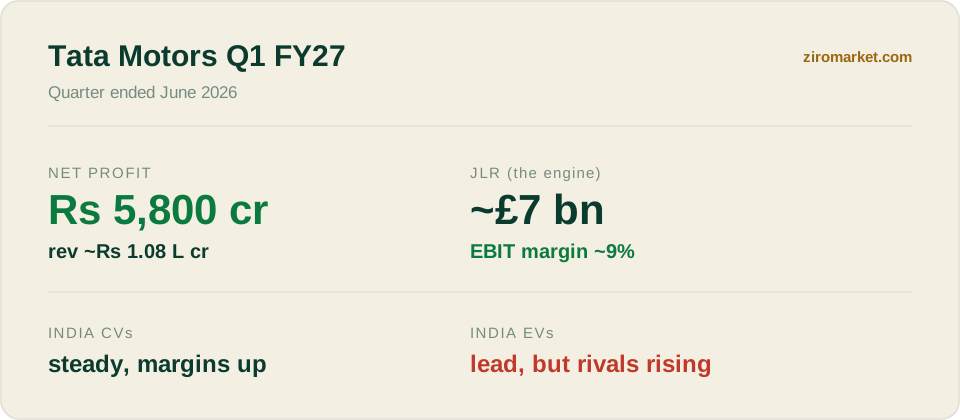
India's most global carmaker delivered another JLR-powered quarter. Tata Motors reported Q1 FY27 net profit of about Rs 5,800 crore on revenue near Rs 1.08 lakh crore, driven by Jaguar Land Rover's firm luxury demand, while its Indian trucks held steady and its EV business defended its lead against rising competition. For a company that is half British luxury and half Indian industry, the balance tilted, as usual, toward JLR.
The result is a read on two very different worlds at once: high-end consumers in Europe, China and North America, and the industrial and EV demand at home. This quarter, the overseas luxury side carried it.
What Happened
JLR did the heavy lifting again. Jaguar Land Rover reported revenue near £7 billion and an EBIT margin around 9%, helped by strong demand for its most profitable models, the Range Rover, Range Rover Sport and Defender. A mix skewed toward these high-margin vehicles is what keeps JLR's profitability firm even when overall volumes are steady rather than surging.
The India businesses were a study in contrasts. The commercial vehicle arm, which sells trucks and buses, was steady with improving margins, reflecting a stable industrial demand backdrop. The passenger vehicle business, near Rs 13,000 crore in revenue, held its position as India's EV leader but felt the heat of new competition.
The balance sheet stayed a strength. Tata Motors has cut its net automotive debt sharply over recent years, moving toward a net-cash position in its auto business, which gives it room to invest in electric vehicles and new JLR models without the heavy debt that once weighed on the stock.
The Three Engines
Tata Motors runs three very different businesses under one roof.
Why This Matters for Investors
Tata Motors is a bet on global luxury as much as Indian autos. Because JLR drives most of the profit, the stock tracks high-end demand in Europe, China and North America more than Indian car sales, which makes it a different kind of auto play from a domestic name like Maruti, as our Maruti Suzuki Q1 FY27 results coverage shows. That global exposure cuts both ways.
The EV story is the domestic swing factor. Tata pioneered electric cars in India and still leads, but rising competition from Mahindra, MG and others is eroding that lead, so how it defends share with new models and pricing is central to the India passenger business.
The currency angle runs through it all. JLR earns in pounds and dollars, so a weak rupee lifts the rupee value of its overseas profit, as our rupee vs dollar today page tracks, one reason the timing of the result, with the rupee near a record low, flattered the reported numbers.
Market Reaction
The stock tends to move on JLR's margin and outlook more than the headline profit. A firm 9% JLR margin and steady luxury demand are the details that reassure, so the market's focus will be on whether that momentum can hold through the year.
Analysts will scrutinise JLR's order book and demand in China and North America, the swing markets for luxury, along with any commentary on tariffs and global trade that could affect exports. The EV market-share trend and the commercial vehicle cycle are the domestic watch points.
The read-across for autos is nuanced. Unlike Maruti's domestic, mix-led quarter, Tata Motors' result says more about global luxury and Indian industrial demand than about the mass-market Indian car buyer.
What Investors Should Watch
The first thing to watch is JLR demand and margin. Because JLR drives the profit, its order book and margin trajectory are the most important numbers in the result.
The second is EV market share. Whether Tata defends its lead against new rivals will shape the India passenger business.
The third is the commercial vehicle cycle and the balance sheet, both of which have been quiet strengths that support the medium-term story.
Risks to Monitor
The clearest risk is a slowdown in global luxury demand. Weakness in China, Europe or North America would hit JLR, and therefore Tata Motors, hardest.
A second risk is EV competition. If rivals keep gaining share, Tata's domestic passenger business could see pressure on volumes and margins.
The third is trade and currency. Tariffs on autos or a sharp rupee move could swing JLR's reported profitability in either direction. This is general information, not investment advice.
Tata Motors' quarter shows a company still powered by British luxury, cushioned by a strong balance sheet, and fighting to keep its Indian EV crown. JLR carried it again, but the questions that will decide the stock, global luxury demand and the EV battle at home, are only getting louder as the auto earnings season rolls on.