The auto earnings season has opened with a study in contrasts. Maruti Suzuki and Tata Motors, the first two big carmakers to report Q1 FY27, delivered very different quarters: Maruti on domestic SUVs and record exports, Tata on Jaguar Land Rover's luxury demand abroad. Same sector, almost opposite business models, and both leaning on the premium and export end rather than the mass market.
That split is the story of Indian autos right now. The affluent and overseas buyer is active; the budget buyer at home is not.
Update, September 2026: Tata Motors has opened a 3.82 billion euro tender offer for Iveco, covered in our Tata Motors Iveco deal analysis.
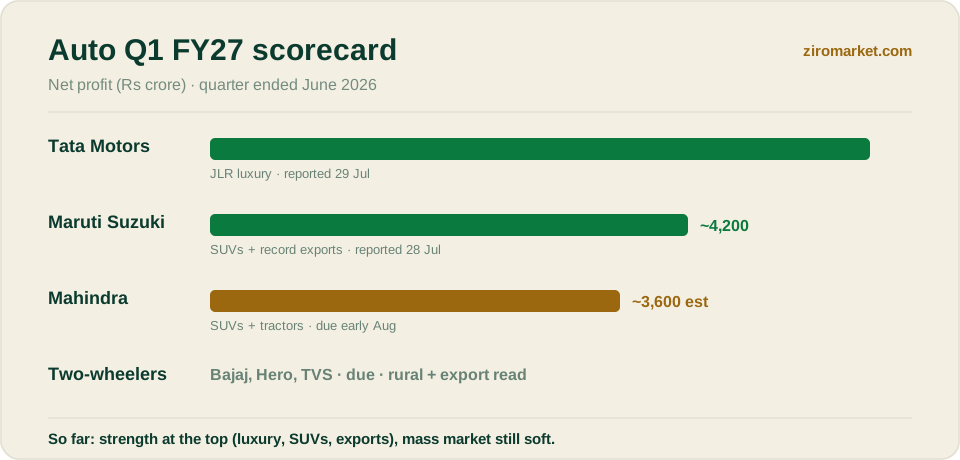
The Q1 FY27 scorecard so far
Here is how the sector stacks up, with the names still to report shown as due.
Tata Motors made the bigger profit, but on a completely different engine: overseas luxury rather than Indian cars. Maruti earned less but is the purer read on the domestic market, which makes the two a useful pair for understanding the whole sector.
Two Models, One Sector
Maruti is the domestic barometer. Its Rs 4,200 crore quarter, up 8%, was carried by higher-margin SUVs and a record 90,000 units of exports, while its traditional small-car base stayed weak, as our Maruti Suzuki Q1 FY27 results coverage details. When Maruti's small cars are soft, it tells you the budget buyer is still cautious.
Tata Motors is the global-luxury play. Most of its Rs 5,800 crore profit came from Jaguar Land Rover, where firm demand for Range Rover and Defender models held the margin near 9%, as our Tata Motors Q1 FY27 results piece explains. Its India trucks were steady and its EVs kept their lead against rising competition.
What Is Still To Come
The picture is only half-drawn. Mahindra, the SUV and tractor leader, reports in early August, and its tractor business will show how rural demand is holding up against a below-normal monsoon, as our Mahindra Q1 FY27 preview sets out. Tractors are the clearest rural read in the whole market.
The two-wheeler makers matter just as much for the mass-market signal. Bajaj Auto, Hero MotoCorp and TVS sell to exactly the price-sensitive buyer who has been cautious, so their volumes and any sign of a rural recovery will complete the demand picture that Maruti and Tata have only partly revealed.
The commercial vehicle read is the third piece. Trucks and buses are a barometer of industrial and infrastructure activity rather than household spending, so the CV commentary from Tata Motors and Ashok Leyland shows whether the investment side of the economy is firm. A steady CV cycle alongside strong SUVs would suggest both the consumer and the industrial engines are running, while weakness there would flag a narrower recovery led only by premium buyers.
Why This Matters for Investors
Autos are a window into consumption. Because vehicles are big-ticket purchases, their volumes and mix show how confident households feel, which matters far beyond the sector. So far the message is uneven: strength at the top, caution at the bottom.
The export and currency angle runs through it. A weak rupee lifts the value of overseas earnings for both Maruti's exports and Tata's JLR profits, as our rupee vs dollar today page tracks, flattering the reported numbers even where domestic demand is soft.
For the market, autos are a key part of the Q1 FY27 picture now that IT and banks are done, and a broad-based recovery, including small cars, tractors and two-wheelers, would be a stronger signal than the premium-led growth seen so far.
Risks to Monitor
The clearest risk is a prolonged mass-market slump. If small cars and entry two-wheelers stay weak, the sector's growth rests too narrowly on SUVs, luxury and exports.
A second risk is the monsoon and rural demand, which will shape Mahindra's tractors and two-wheeler volumes.
The third is global luxury demand and trade, which drives Tata Motors through JLR and could swing with tariffs or a slowdown abroad. This is general information, not investment advice.
Two results in, Indian autos look healthy at the top and soft at the bottom, with the same weak rupee helping both leaders. The fuller verdict waits on Mahindra's tractors and the two-wheeler makers, because whether this is a broad recovery or a premium-only one depends on the buyers who have not shown up yet. For the electric angle and one of the market's most watched turnarounds, see our Ola Electric 2026 piece, and for where autos placed against every other sector this season, our India Inc Q1 FY27 scorecard.