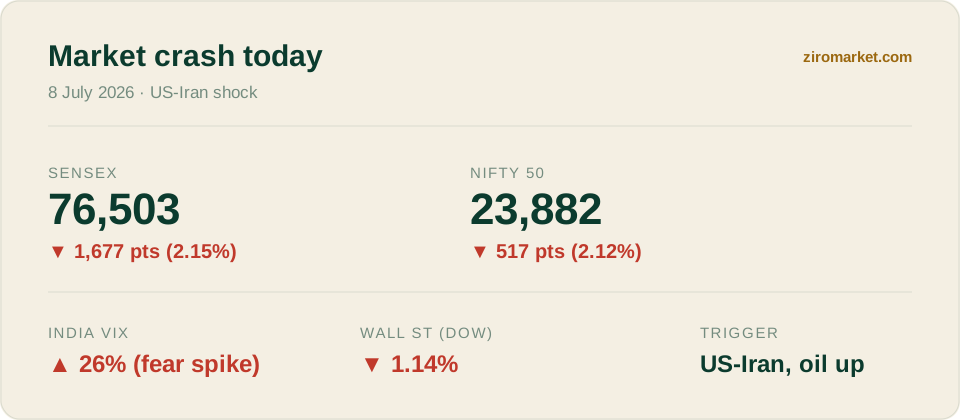
Markets had a brutal Wednesday, and the trigger was a headline no trading screen could price in advance. On July 8, 2026, the Sensex crashed 1,677 points to 76,503 and the Nifty fell below 23,900, both down more than 2% in their worst session in over three months, as US President Donald Trump declared the Iran ceasefire over, fresh US-Iran strikes hit the Strait of Hormuz, and oil surged, dragging Wall Street lower too. From Mumbai to New York, the fear was the same: a wider war and a supply shock in oil.
This was not a slow drift lower. The India VIX, the market's fear gauge, jumped about 26% in a single day, the signature of a genuine risk-off shock rather than ordinary profit-taking.
What Happened
The sell-off was synchronised across the world. In India, the Sensex ended down 1,677.12 points at 76,503.60 and the Nifty 50 fell 516.65 points to 23,882.05, both shedding more than 2%, with IndiGo and Jio Financial among the biggest losers. The Nifty sliced back below the 200-day average it had reclaimed only two days earlier, erasing a four-day rally in a single session.
In the United States, the mood was just as grim. The Dow Jones Industrial Average fell about 1.14%, the S&P 500 dropped around 0.65%, the Nasdaq lost about 0.50%, and the small-cap Russell 2000 fell around 0.90%. Investors rotated into defensive corners like healthcare, biotech, financials, and insurance, the classic footprint of a market bracing for trouble rather than chasing growth.
The common thread was oil and Iran. President Trump declared the tentative ceasefire with Iran effectively over as the two sides exchanged strikes near the Strait of Hormuz, and Washington revoked Iran's ability to sell oil on the global market, as detailed in our coverage of the US strikes on Iran. Crude jumped about 3%, and equities everywhere fell in response.
Why This Matters for Investors
The crash was really an oil story wearing a geopolitics mask. Because India imports more than 85% of its crude, a spike in oil hits the country on multiple fronts at once, the import bill, the rupee, and inflation, which is why the Nifty fell harder than Wall Street. Our explainer on how crude oil affects the Indian economy lays out exactly how one commodity ripples through the whole system.
The currency compounded the pain. The rupee slipped under fresh pressure as oil rose, a link covered on our rupee vs dollar today page, and a weaker rupee makes imported inflation worse. Oil and gas and FMCG stocks led the domestic fall, tracked in our Indian stock market today wrap, while crude oil prices jumped to near $76 a barrel for Brent.
Not everything fell, though. Gold firmed as a safe haven, and crypto held up on separate rate-cut hopes, a reminder that a crash reshuffles money rather than destroying it. You can see the moves on our gold price today and bitcoin price today pages, where the divergence from equities was stark.
Market Reaction
The reaction was textbook fear. A 26% jump in the India VIX shows traders suddenly pricing far more uncertainty, and the rush into defensives on Wall Street told the same story in a different market. When volatility spikes this fast, it usually reflects a shock the market had not been positioned for.
The technical damage was real too. The Nifty breaking back below its 200-day average and below 23,900 undid the bullish signal from earlier in the week, and traders will now watch whether these levels turn from support into resistance. A sharp single-day fall on a headline can reverse just as quickly, but only if the headline itself improves.
What Investors Should Watch
The first thing to watch is the Strait of Hormuz and oil. Because the crash was driven by the crude spike, the direction of oil prices will set the market's tone, with any further escalation likely to deepen the sell-off and any de-escalation likely to spark a bounce.
The second is foreign investor flows. A sustained risk-off move usually brings foreign selling of Indian equities, which pressures both stocks and the rupee, so the flow data is a key signal in the coming sessions.
The third is the Q1 FY27 earnings season, which begins with TCS on July 9, as previewed in our TCS Q1 FY27 results piece. Strong results could steady nerves even amid the geopolitical noise, while weak ones would add to the gloom.
Risks to Monitor
The clearest risk is a wider war. Iran's strikes on US sites in Kuwait and Bahrain raise the danger of the conflict spreading across the Gulf, which would keep oil elevated and markets fragile.
A second risk is sticky, higher oil. If crude holds near or above $76, the hit to India's import bill and inflation could weigh on equities well beyond a single session, turning a one-day crash into a longer drawdown.
The third is a sentiment spiral. A high VIX and heavy foreign selling can feed on each other, so how quickly fear fades matters as much as the news itself. This is general information, not investment advice.
A 2% crash on a war headline is frightening in the moment, but it is worth remembering what actually moved: not India's growth or company earnings, but the price of oil and the temperature of a conflict in the Gulf. For investors, the lesson of July 8 is that in a market this globally connected, the most important chart on some days is not the Nifty at all, but a narrow stretch of water called the Strait of Hormuz.